
Guide
Street Food in Thailand: The 12 Most Important Dishes, Prices and Hygiene Tricks
The 12 most important street food dishes in Thailand with prices in baht, plus hygiene rules, spice words and tips for vegetarians and people with allergies.
- Category: Daily life
- 18 min read
- Updated:26 October 202626/10/2026
Contents of this article8 sections
In Thailand, most eating happens on the street. Many cooks have made just one dish for years, which is why a plate for 60 baht often tastes better than the portion in a hotel restaurant that costs several times as much. Further down you will find hygiene rules, the most important words for ordering, and the twelve dishes you should know. As of October 2026.
In short
- A plate at an ordinary stall usually costs 40 to 80 baht, a skewer 10 to 15 baht. On tourist streets and on the islands you quickly pay double.
- Go where locals queue, and eat what is cooked hot in front of your eyes.
- The first time, say “phet nit noi” (a little spicy). “Mai phet” (not spicy) often still comes out spicy.
- Almost everywhere you pay in cash. Take 20 and 50 baht notes with you.
- Vegetarian and vegan eating works if you expressly ask them to leave out fish sauce and shrimp paste. The keyword is “jay”.
Where and when to eat
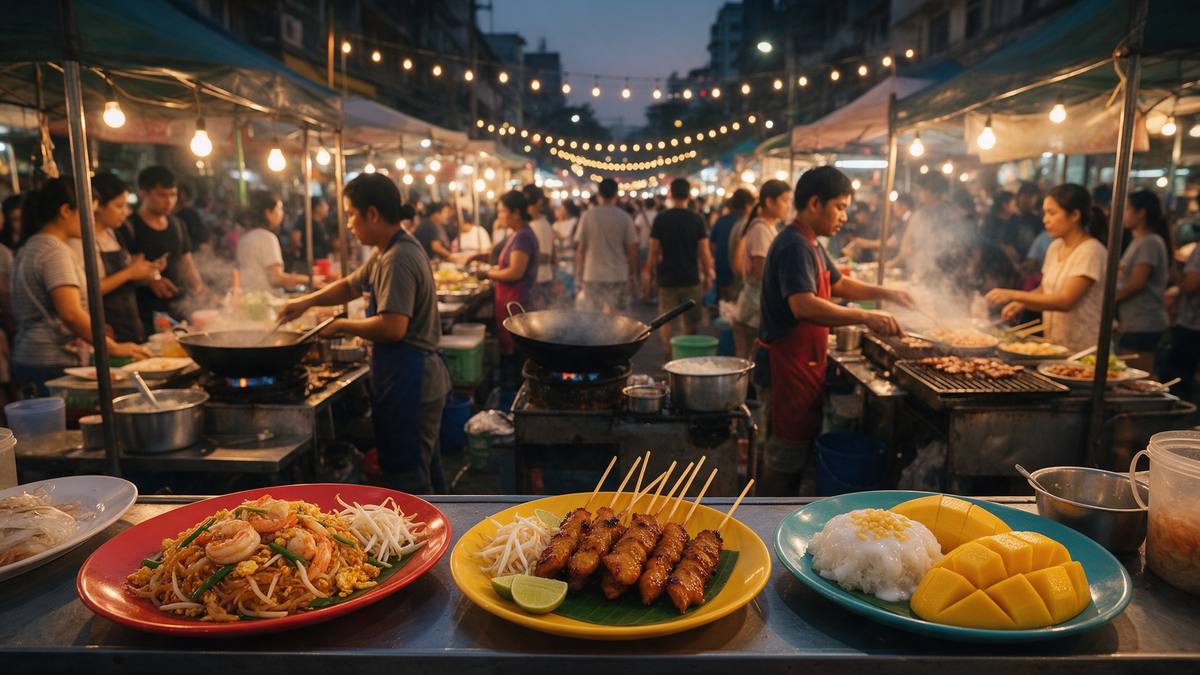
There are three forms. Mobile carts sell skewers, fruit and roti. Shophouse stalls have plastic stools that spill onto the pavement and usually cook only one or two dishes. Night markets gather dozens of stalls in one place from late afternoon. Then there are the food courts in shopping centres: air-conditioned and clean, usually a little more expensive than a street stall. There you often top up a card or buy coupons and pay with them at the stalls. In Bangkok, the food court at Terminal 21 is a common way in if the heat gets too much.
The day has its own rhythm:
- Morning (6 to 9 am): Rice porridge (jok), grilled pork skewers with sticky rice, fried dough sticks with soy milk.
- Midday (11 am to 2 pm): Rice and curry stalls, noodle shops. Many close as soon as the pot is empty. The well-known khao soi and chicken rice places are often sold out by early afternoon.
- Evening (from 5 pm): Night markets and whole streets such as Yaowarat Road in Bangkok’s Chinatown. There the stalls stand packed together from about 5 pm until midnight, and it is busiest towards the weekend. Many stalls in Bangkok close on Mondays, so do not plan your big evening for a Monday.
If you want to eat like a local, look for side streets and residential districts. Around the Victory Monument in Bangkok you eat among office workers and students, and in Chiang Mai the Walking Streets on Saturday and Sunday offer long rows of stalls from about 5 pm. In the north-east (Isan), is the home of grilled chicken, larb and som tam. In many places street vendors are being pushed off the pavements, and some famous stalls move or close. Before a trip aimed at one stall, check briefly that it still exists.
What it costs: Most single-plate dishes cost 40 to 80 baht, so roughly 1 to 2 euros. If you eat three meals plus snacks and drinks from stalls, you come to around 300 to 450 baht a day in Bangkok. In Chiang Mai it is a little less, on Phuket and other islands considerably more. There plates often start at 100 to 150 baht. How to recognise tourist prices: no posted prices, a stall right in front of a sight, menus only in English. One or two streets further on you usually pay much less. You can see the whole daily budget in the guide Cost of Thailand per day.
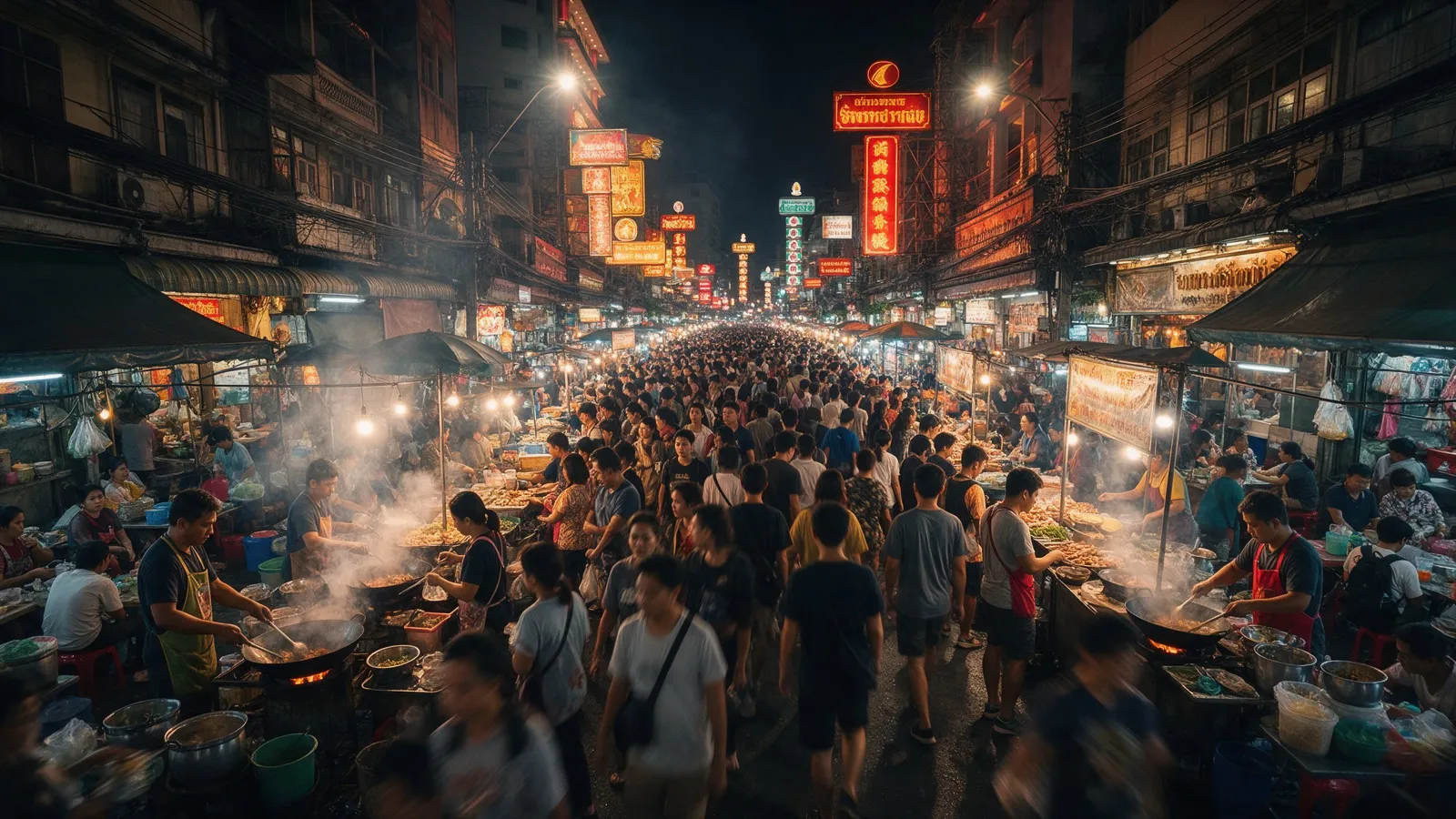
For tasting, hardly any district in Bangkok beats Chinatown around Yaowarat Road. The food stalls open from about 5 or 6 pm, the peak is between 7 pm and 9 pm, and many are closed on Mondays. You can find food tours and guided evening walks on Trip.com.
Hygiene: how to keep your stomach calm
Stomach problems mostly come from food that stood around too long, not from street food itself. A residual risk remains all the same. With a few rules you keep it small:
- A full stall beats an empty stall. Where many locals eat, the ingredients pass through the pot quickly. Plastic stools and a shabby sign are not a bad sign. The best kitchens often look the least smart.
- Hot and fresh. What lands in the wok in front of you, simmers in the soup pot or lies on the grill is safest. Be suspicious of anything that sits lukewarm in bowls in the heat.
- Raw only with care. Raw seafood, raw or half-cooked meat and salads with raw vegetables are the classic triggers. The same goes for cut fruit that has been lying open for a while. Fruit that you peel yourself is the safer choice.
- Bottled water. You do not drink tap water, and you use bottled water to brush your teeth too. A bottle costs about 10 baht, and at refill machines the water is cheaper still.
- Ice. The cylindrical ice with the hole in the middle comes from factories and is considered unproblematic. Loose, crushed ice of unknown origin is better avoided if you have a sensitive stomach. There is also a residual risk with freshly pressed juices and shakes from a stall. If you want to be on the safe side, skip them or order them without ice.
- Hands and crockery. Hand sanitiser and tissues belong in your backpack, because many stalls have no napkins and no sink. The crockery is often rinsed in bowls of washing-up water. So I wipe the spoon with a tissue if it is still dripping. That is my habit, not a rule.
- Settling in. In the first few days, eat cooked food rather than ten new dishes in one evening. The body needs some time to get used to new germs, different oil and spice. Electrolyte powder and an anti-diarrhoea remedy belong in the travel first-aid kit, more on this in the guide Health in Thailand.
When it comes to spice there is a first-aid rule of its own: if your mouth is burning, water hardly helps. Better are rice, a pinch of sugar, milk or a sweet drink such as Thai iced tea. These are everyday tricks and not medical advice.
Ordering and spice words
Many cooks speak hardly any English, but that is not a problem, because most stalls make only one or two dishes. Point at what your neighbour is eating, or call the dish by name. With these words you will get by almost anywhere:
| Thai | Pronunciation | Meaning |
|---|---|---|
| ไม่เผ็ด | mai phet | not spicy |
| เผ็ดนิดหน่อย | phet nit noi | a little spicy |
| เผ็ดมาก | phet mak | very spicy |
| ไม่ใส่ … | mai sai … | without … (for example without sugar: mai sai nam tan) |
| ไม่ใส่น้ำปลา | mai sai nam pla | without fish sauce |
| เจ | jay | vegan (Buddhist-influenced cuisine) |
| ไข่ดาว | kai dao | fried egg |
| เอาอันนี้ | ao an nii | I’ll take this one |
| เท่าไหร่ | tao rai | how much is it? |
| กลับบ้าน | klap baan | to take away |
| อร่อย | aroi | delicious |
Thai spicy is on a different scale from German spicy. With som tam, larb and everything from the north-east, even “mai phet” is often still clearly noticeable. If you are very sensitive, say “mai phet loei” (not spicy at all) or order mild dishes such as khao man gai, pad see ew or jok from the start. You can always add more seasoning, but never take it away. On almost every table there is a set with sugar, fish sauce with chilli, chilli flakes and chilli in vinegar. Taste first and then season yourself, as the Thais do.
You eat with a fork and spoon. The fork pushes the food onto the spoon, and the spoon goes into your mouth. Chopsticks only come with noodle soups. Tipping is not usual at a street stall.
Paying
At street stalls you almost always pay in cash. Have 20 and 50 baht notes ready, because many vendors can hardly give change for a 1,000 baht note. There is no haggling, the prices are fixed. Some stalls show a PromptPay QR code, but for that you usually need a Thai bank account or a suitable travel app. At larger markets and in food courts some things are paid by card or prepaid credit, with cards sometimes carrying a surcharge. How to get cash without paying extra in fees is in the guide Money and payments in Thailand.
Allergies and eating vegetarian
Fish sauce, shrimp paste, oyster sauce, peanuts and dried shrimp are in many dishes, including ones that look harmless at first glance. If you react allergically, you should say so clearly and ideally carry a card in Thai that says what you cannot tolerate. In Thai, “I am allergic to …” is “phom phae …” for men and “chan phae …” for women, followed by “thua lisong” (peanut) or “kung” (shrimp). With severe allergies, a stall with a shared wok and unclear sauces is a risk you should not take. Go to a restaurant instead, where you can ask questions.
Eating vegetarian works well if you ask them to leave out the standard ingredients: “mai sai nam pla” (without fish sauce), with som tam also “mai sai pla ra” (without fermented fish), and with pad thai “mai sai kung haeng” (without dried shrimp). The safest are stalls with a yellow flag and red lettering “เจ” (jay). This is vegan cuisine in the Buddhist tradition, without meat, fish, eggs and dairy products, often also without garlic and onions. During the Vegetarian Festival, especially on Phuket, many stalls switch to meat-free. The date moves from year to year, and in 2026 the festival ran from 10 to 18 October.
The 12 most important dishes
Pad Thai
 AI image
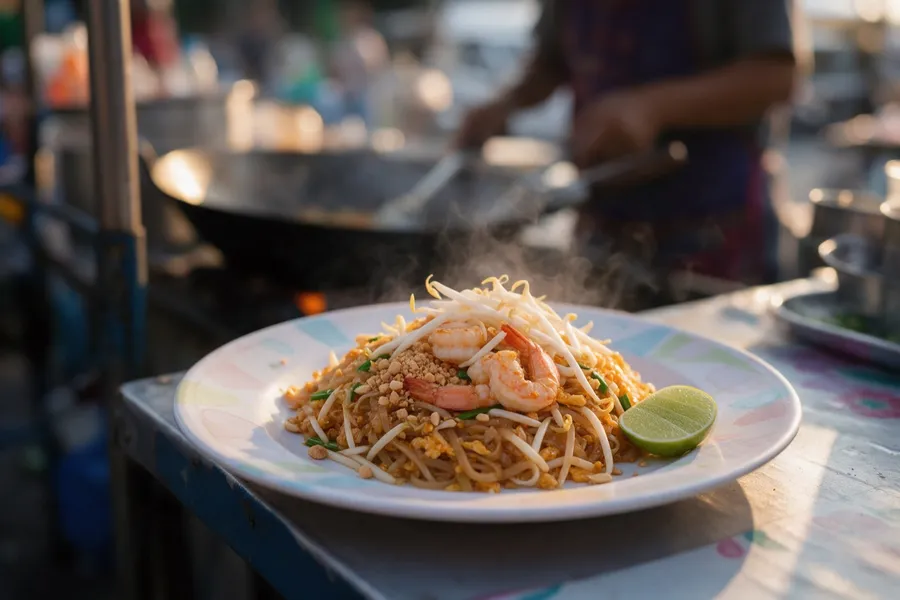
Pad thai (ผัดไทย, pronounced “phat thai”) is rice noodles fried in a pan with egg, tofu, bean sprouts, chives, peanuts and optionally prawns or chicken. The flavour lies between sweet, sour and salty, with tamarind giving the sourness. The dish is not spicy by default, you sprinkle the chilli flakes on yourself. A good plate costs about 50 to 70 baht at an ordinary stall, and quickly 100 to 160 baht in tourist zones. What matters is a hot wok, so that the noodles fry and do not boil. As a vegetarian, expressly ask them to leave out fish sauce and dried shrimp.
Pad Kra Pao
 AI image
Pad kra pao (ผัดกะเพรา, “phat kaphrao”) is stir-fried minced meat, usually pork, with garlic, lots of chillies and holy basil, served on rice. A crispy fried egg goes with it, which you order for 10 to 15 baht extra as “kai dao”. The dish is savoury, salty and distinctly spicy, so say “phet nit noi”. With egg you pay about 60 to 90 baht depending on the area. For many Thais it is the quintessential everyday meal. If you do not know what to order, have that.
Khao Pad
 AI image
Khao pad (ข้าวผัด, “khao phat”) is fried rice with egg, onions and tomatoes and the meat of your choice: pork (moo), chicken (gai), prawns (kung). There are usually cucumber slices and a lime wedge with it. The flavour is mild, and the dish is a classic for beginners and for anyone who does not feel like experimenting right now. 50 to 70 baht is usual. Season at the table with fish sauce with chilli (“prik nam pla”), and the plain rice becomes a proper dish.
Som Tam
 AI image
Som tam (ส้มตำ) is a salad of green, unripe papaya, pounded in a clay mortar with chilli, garlic, lime juice, fish sauce, tomatoes, beans and peanuts. It tastes crunchy, sour, salty and slightly sweet, and is quite spicy by default. So say right away how many chillies you can take. The “Som Tam Thai” version is sweeter and nuttier, while “Som Tam Poo Pla Ra” with fermented fish and salted crab is much more intense and smells strong. The crab is usually raw, so not for a sensitive stomach. A plate costs about 40 to 70 baht. Sticky rice and grilled chicken are typical with it.
Moo Ping
 AI image
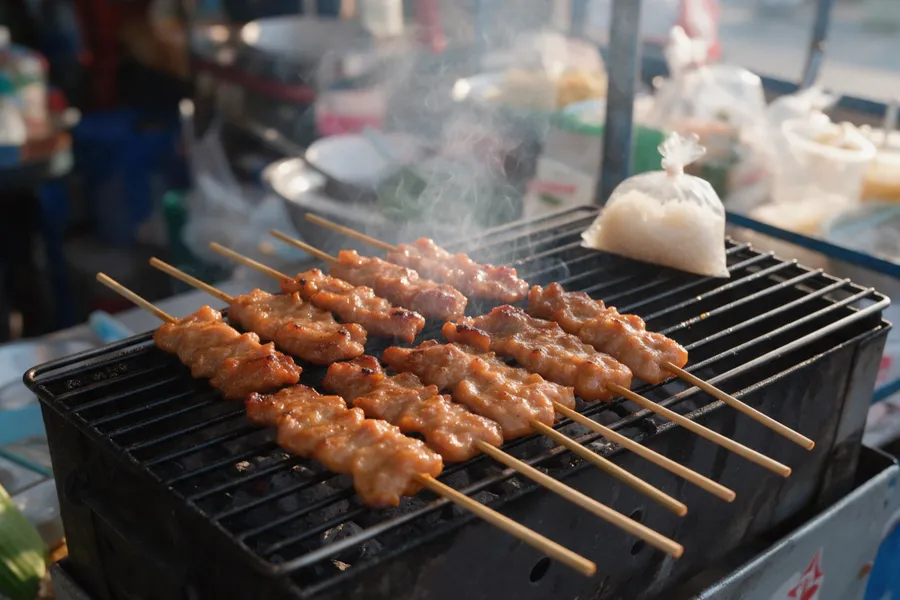
Moo ping (หมูปิ้ง) are sweet-salty marinated pork skewers from the charcoal grill, usually with a bag of sticky rice (khao niao). They are a classic Thai breakfast and a snack between meals. The skewers taste caramelly and slightly smoky and are not spicy. A skewer costs about 10 to 15 baht at morning markets, and 25 to 40 baht on tourist streets. Get them fresh off the grill and not from a pile that has been lying in the sun for a while. With three skewers and a bag of sticky rice you are full.
Khao Man Gai
 AI image
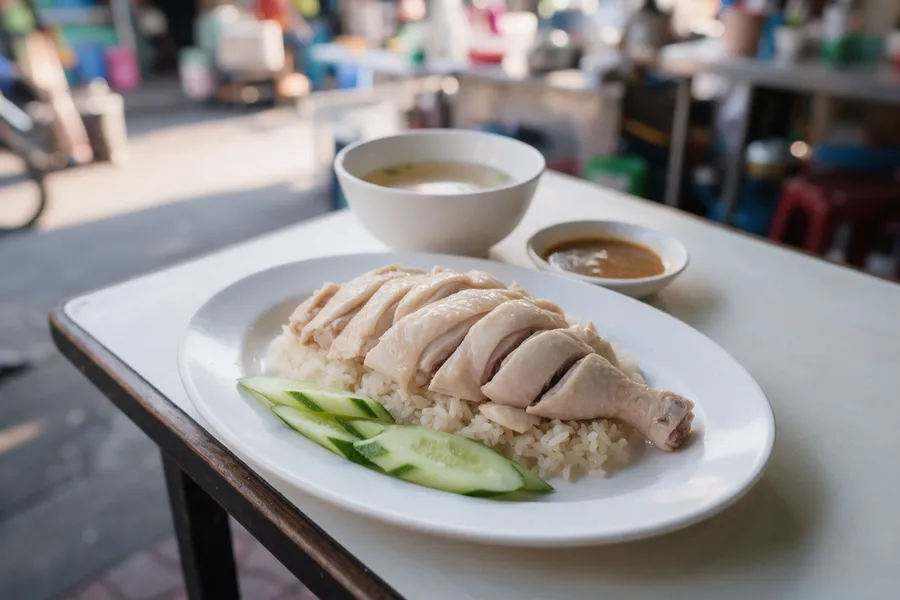
Khao man gai (ข้าวมันไก่) is poached chicken on rice that is cooked in chicken fat and stock. With it comes a sauce of ginger, garlic and fermented soybeans and a small bowl of clear broth. The dish is mild and a good choice for the first days and for sensitive stomachs. You pay about 40 to 80 baht. Go early, because the well-known places are sometimes sold out by early afternoon. The sauce is worth it, so ask for it if it does not land on the table by itself.
Kuay Teow
 AI image
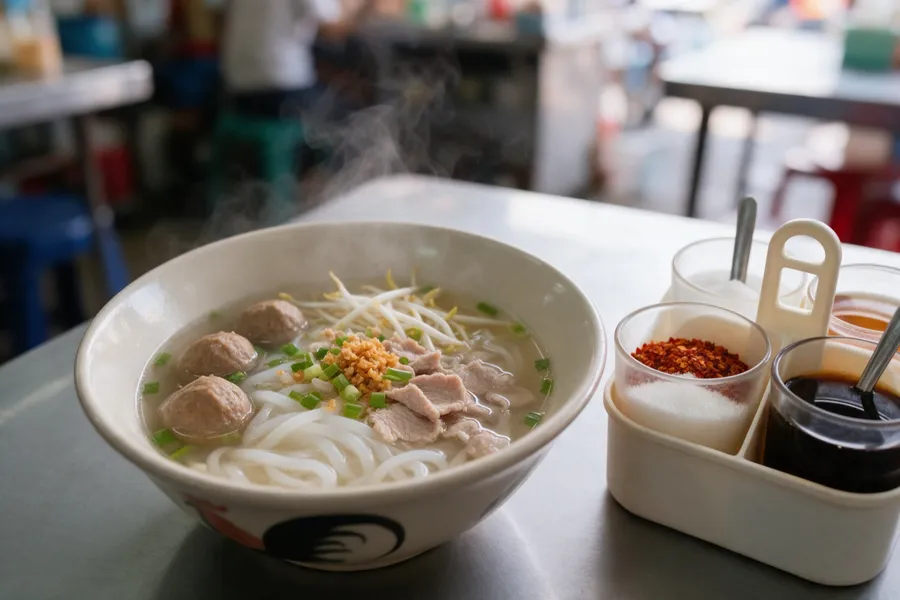
Kuay teow (ก๋วยเตี๋ยว) is the quintessential Thai noodle soup. You choose the type of noodle (narrow or wide rice noodles, thin glass noodles, egg noodles), the meat (pork, beef, fish balls) and whether with broth or dry. The broth is hearty, sometimes clear, sometimes strong and dark. You season at the table: sugar, fish sauce, chilli flakes and chilli in vinegar stand ready. A normal bowl costs about 40 to 70 baht. As “boat noodles” (kuay teow reua) there are tiny bowls with a very strong, dark broth for 15 to 25 baht each. You order several in a row. The dark broth is traditionally thickened with a little blood. If you do not like that, ask beforehand.
Pad See Ew
 AI image
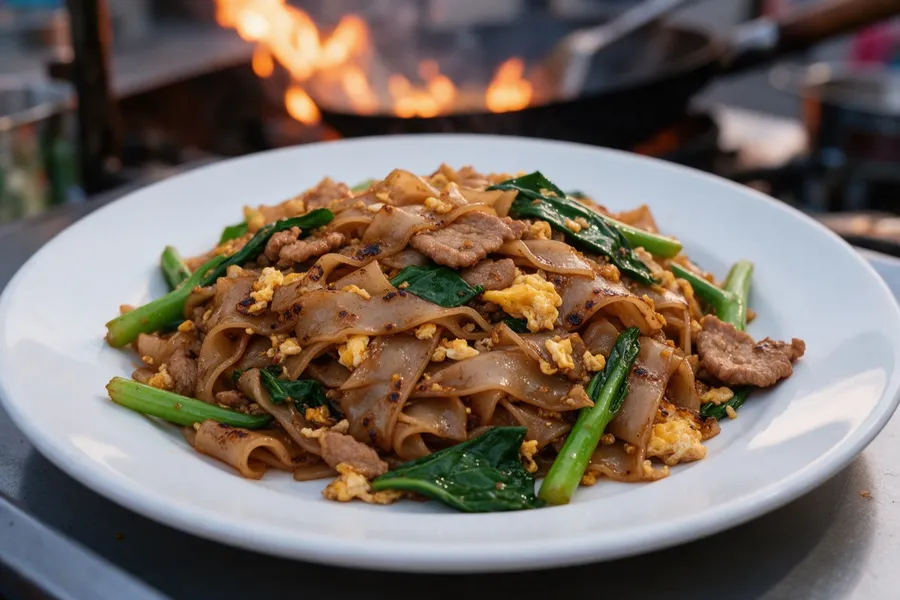
Pad see ew (ผัดซีอิ๊ว, “phat si-io”) is wide rice noodles fried in a very hot wok with dark soy sauce, egg and Chinese broccoli (gai lan). The flavour is sweetish, slightly salty and smoky, and the dish is not spicy. It is a good substitute when you are fed up with pad thai, and the choice for anyone who avoids spice. Expect 50 to 80 baht. You recognise good stalls by the slightly charred edge of the noodles, the wok aroma. Chilli in vinegar (“prik nam som”) adds freshness.
Khao Soi
 AI image
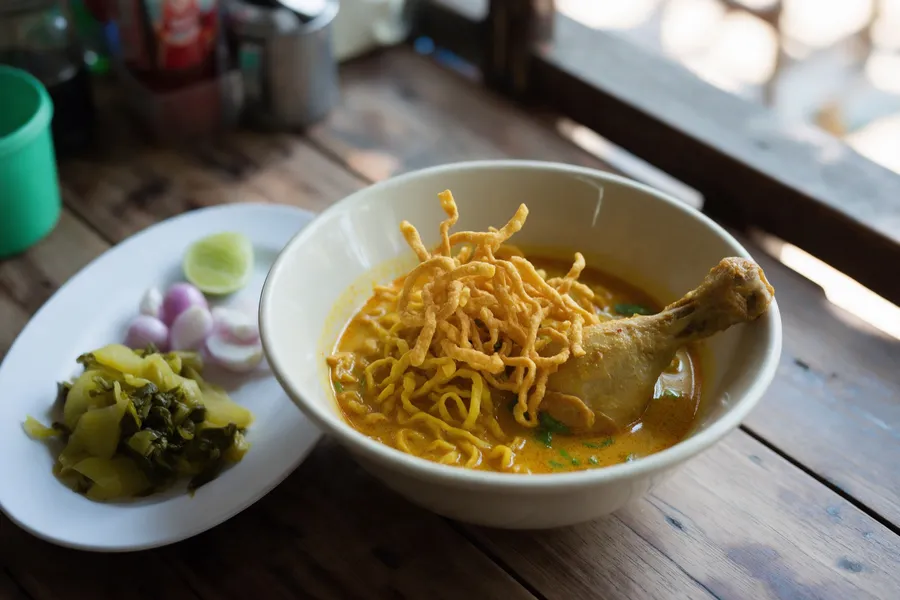
Khao soi (ข้าวซอย) comes from the north and is the great speciality of Chiang Mai and Chiang Rai. It is a curry soup with coconut milk, egg noodles in the broth and a handful of fried noodles on top, with chicken or beef. At the table, red onions, pickled mustard greens and lime are added. The soup is creamy, savoury and medium spicy and costs about 60 to 100 baht. Eat it at midday, because the good places often sell out early.
Gai Yang
 AI image
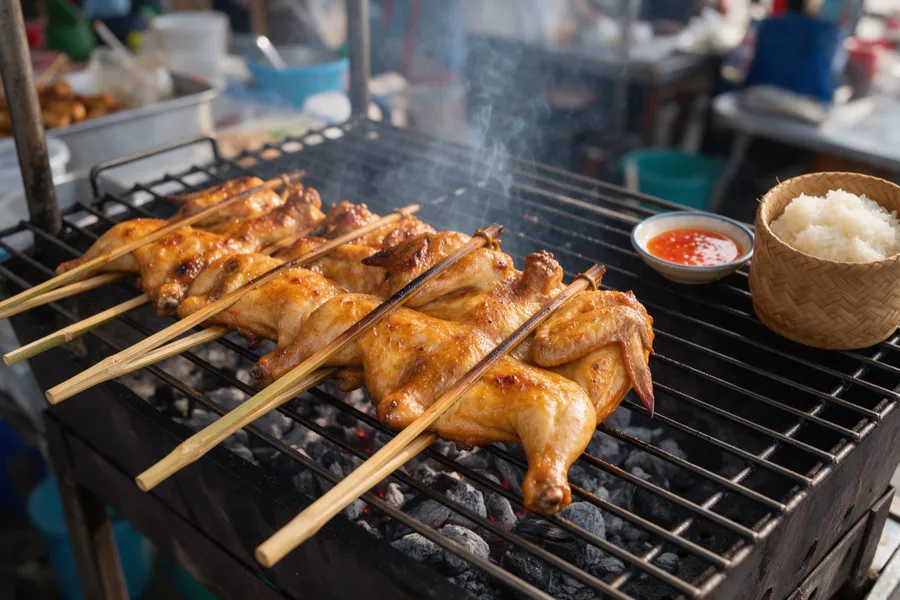
Gai yang (ไก่ย่าง) is a chicken that is marinated and grilled slowly over charcoal. It is a speciality from the north-east (Isan). The skin is crispy, the meat juicy and flavoured with garlic and pepper. With it you eat sticky rice and “nam jim jaew”, a smoky, spicy chilli dip. The chicken is not spicy, the dip is. The price depends on the size and the area, so ask with “tao rai?” before you order. A whole chicken is often shared between two, and som tam and sticky rice go with it. Make sure the meat is cooked through and hot.
Mango Sticky Rice
 AI image
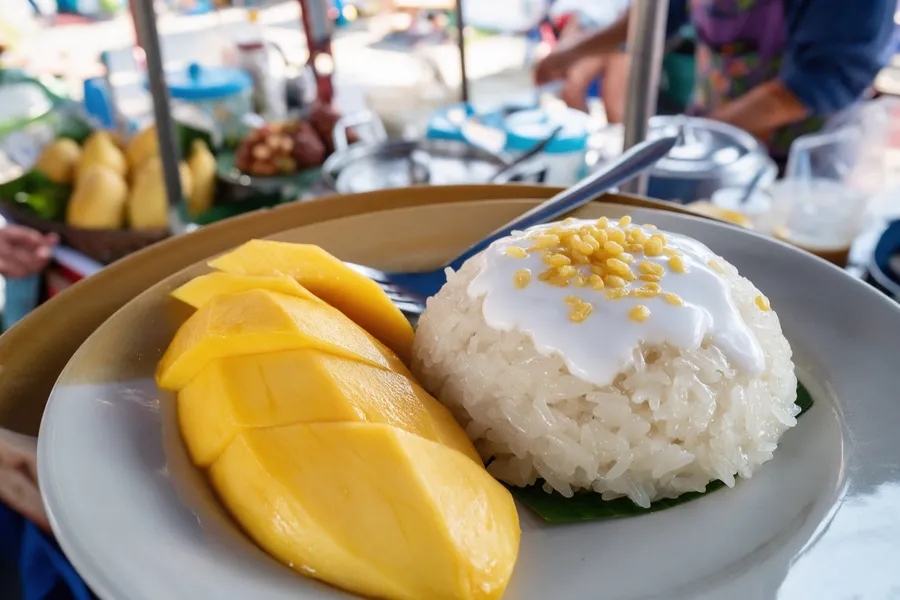
Mango sticky rice (ข้าวเหนียวมะม่วง, “khao niao mamuang”) is the best-known dessert: sweet sticky rice with coconut milk and fresh, ripe mango, often sprinkled with roasted mung beans or sesame. It tastes sweet, creamy and fresh, and nothing about it is spicy. The ingredients are plant-based, but ask if in doubt. In season, roughly from March to June, the mango tastes best. A plate costs about 50 to 100 baht at markets, and quickly 100 to 180 baht in tourist areas. Before buying, check that the mango is ripe and the portion freshly cut.
Roti
 AI image
Roti (โรตี) comes from Indian-Muslim cuisine. At the stall the dough is stretched paper-thin and baked on the griddle. For the best-known street variant, roti gluay (โรตีกล้วย, “roti kluai”), banana is added, and on request egg, condensed milk and sugar. The result is crispy outside, soft inside and very sweet. Depending on the filling you pay about 40 to 80 baht. Savoury roti is also served as a side with curry. After a spicy dish it is a good finish.
What you are better off leaving
Street food is safer than its reputation, but not every stall and not every dish. I am careful with these things:
- Raw or half-raw seafood and raw meat, especially in the heat and at stalls with little trade. Grilled or freshly fried prawns and squid are fine if the goods were kept cool and are served hot.
- Reheated and lukewarm food that has been in the display for a while.
- Raw salads and garnishes on the first day, if your stomach is sensitive. This also applies to fruit in a bag with salt and chilli sugar. Freshly cut and chilled, the risk is smaller, but it is never gone entirely.
- Tap water, also for the toothbrush, and ice cubes of unknown origin.
- Stalls with no trade, even if the price sounds tempting. An empty stall at midday usually has a reason.
- Too much at once. Five new dishes on the first evening in Chinatown take their revenge faster than any single stall.
If you are unsure, start with cooked food such as khao man gai, khao pad or pad see ew. More on scams and safety on the road is in the guide Scams and safety in Thailand.
Frequently asked questions
Is street food in Thailand safe?
For most travellers, yes. Look for stalls with lots of trade, eat fresh and hot food from the wok or the grill, and drink bottled water. Raw seafood, raw meat and lukewarm food are better left alone. An upset stomach can never be completely ruled out.
What does street food in Thailand cost in 2026?
At ordinary stalls a plate usually costs 40 to 80 baht, a skewer 10 to 15 baht, a small bowl of boat noodles 15 to 25 baht. On tourist streets and on islands such as Phuket it is often 100 to 150 baht per plate. A day with three meals from stalls comes to around 300 to 450 baht in Bangkok.
How do I say I do not want it spicy?
Say "mai phet" for not spicy, "phet nit noi" for a little spicy. Thai spicy is stronger than many expect. The first time, go for "phet nit noi" or "mai phet loei" (not spicy at all). You can add more seasoning at the table.
Can I eat street food in Thailand as a vegetarian?
Yes, but you have to be careful, because fish sauce, oyster sauce and shrimp paste are standard ingredients. Order "mai sai nam pla" (without fish sauce) or look for stalls with a yellow flag and the lettering "jay", which cook purely vegan.
How do I pay at a street stall?
Almost always in cash. Have 20 and 50 baht notes ready, because many vendors cannot give change for 1,000 baht. A PromptPay QR code at the stall usually only works with a Thai bank account or a suitable travel app.