

North
Chiang Rai
Chiang Rai: White, Blue and Black Temples with admission and hours, markets by day of the week, food, Golden Triangle, bus and flight, tips on air and border.
Updated: 19 October 2026
Region
North
White Temple and the Golden Triangle
Best time to visit
November to February: dry, warm by day, cool at night. March and April are hot and often hazy, July and August are the wettest.
Getting there
Flight from Bangkok (Don Mueang or Suvarnabhumi) about 1 hr 20 to 1 hr 35 min, bus about 10 to 12 hrs
Top highlights
- White Temple Wat Rong Khun south of the city
- Wat Phra Kaeo, where the Emerald Buddha was found
- Golden Triangle on the Mekong with views of Laos and Myanmar
Rain and temperature through the year
- Jan8 mm, 29 °C, drynow
- Feb14 mm, 31 °C, drynow
- Mar28 mm, 34 °C, drynow
- Apr98 mm, 35 °C, changeablenow
- May213 mm, 33 °C, rainy seasonnow
- Jun178 mm, 32 °C, rainy seasonnow
- Jul311 mm, 31 °C, rainy seasonnow
- Aug358 mm, 31 °C, rainy seasonnow
- Sept284 mm, 31 °C, rainy seasonnow
- Oct125 mm, 30 °C, changeablenow
- Nov59 mm, 29 °C, drynow
- Dec14 mm, 27 °C, drynow
Line: average daily high in °C. Band and number: rain in mm per month · Weather data: Station Chiang Rai · Source: Thai Meteorological Department (TMD), Klimamittel 1981–2010, gerundet · Weather in Chiang Rai in detail
Contents of this article8 sections
Chiang Rai lies on the Kok River, in the far north. The province of the same name is the northernmost in Thailand and the gateway to the Golden Triangle, where Thailand, Laos and Myanmar meet. King Mengrai founded the city in 1262, even before Chiang Mai. In the mountains all around live the Hmong, Lahu, Lisu, Akha and Karen, each with their own languages and costumes. The city itself is small and relaxed, and you can reach most of the province’s sights as day trips.
Life in the city centres on the clock tower and the night market, which are close together. The well-known temples lie a little outside, as do the mountains and the Golden Triangle.
Getting there
Flying is the most comfortable option. A direct flight from Don Mueang or Suvarnabhumi takes about 1 hour 20 minutes to 1 hour 35 minutes. When booking, check which of the two Bangkok airports your flight leaves from, as they are far apart. Mae Fah Luang Airport is about 8 to 10 kilometres north of the city centre. Many places to stay will also pick you up.
Buses leave from the Northern Bus Terminal (Mo Chit) in Bangkok. The journey usually takes around 12 hours, 10 to 14 hours by VIP bus depending on the operator, mostly overnight.
There is no train to Chiang Rai. The state railway runs as far as Chiang Mai, and from there you continue by bus. By road it takes about three to four hours. The Green Bus runs about 13 times a day, and a seat on the express bus costs 260 to 290 baht (as of September 2026). If you are going to Chiang Mai anyway, the two are easy to combine.
Getting around
A songthaew ride in the city costs 20 to 30 baht per person, a tuk-tuk 40 to 100 baht. Agree the price beforehand, as there is no meter. Grab works, and a ride in the city or from the airport usually costs 120 to 230 baht. Out by the temples, though, there are often only a few drivers about. From the airport into the city a taxi costs about 150 to 250 baht, and there has been no public shuttle bus since 2024 (as of August 2026).
Where to stay
For a first visit, it is best to stay in the centre around the clock tower and the night market. From there you can reach food, markets and bus station 1 on foot. There are also many small boutique resorts in the province with mountain views, often with their own restaurant and spa. Out there it is quieter, but you then depend on drivers or a shuttle for day trips. A few larger resorts lie on the Kok River.
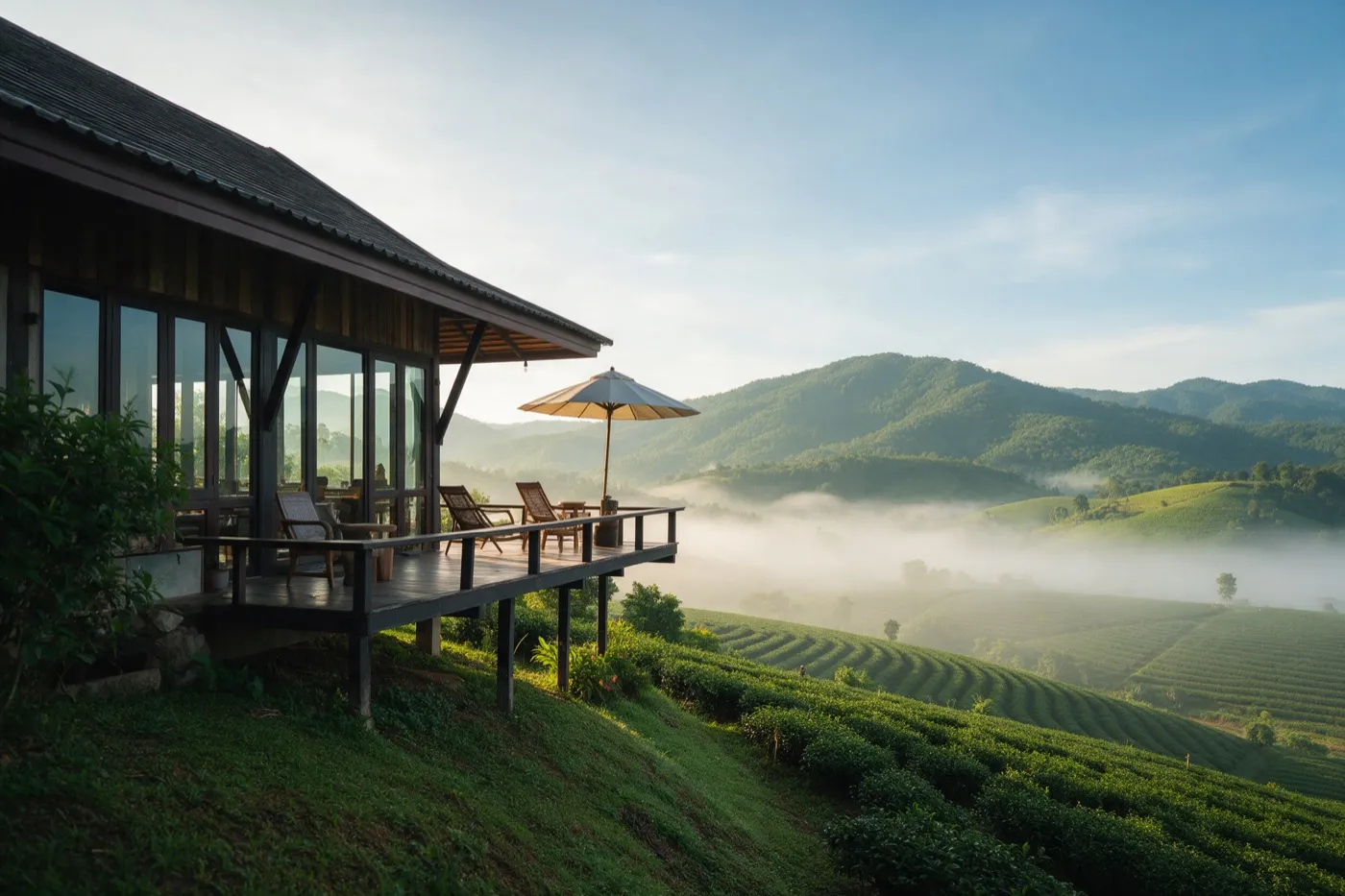
In the centre around the clock tower and the night market you can reach most things on foot. Out in the province there are quiet boutique resorts with mountain views, but for day trips you need a driver or a shuttle. You can compare hotels in the city and the surrounding area in advance.
In the evening
At the clock tower in the centre there is a short light and music show every evening at 19:00, 20:00 and 21:00. It lasts about ten minutes and is free. The tower stands in a roundabout, and you watch from the pavement.
Right next to it, the night market by the bus station is open every evening, from about 17:00 or 18:00 until around 22:30. In the large food area there are free Lanna-style dances from about 19:30. People eat at long tables.
On Saturdays Thanalai Road becomes a walking street, about a kilometre long with stalls and stages, from about 16:00. On Sundays there is a smaller walking street on San Khong Noi Road, more for locals and with plenty of food.
Food
The cuisine in the north is different from Bangkok. A bowl of khao soi, the curry noodle soup with coconut milk, costs 40 to 70 baht, and many places serving it are only open in the morning and at lunchtime. Also typical are khanom jeen nam ngiao, rice noodles in a spicy tomato broth, and the herb sausage sai ua. At the morning markets it is busiest between 6:00 and 8:00, and many stalls pack up before 9:00.
Sights
Wat Rong Khun
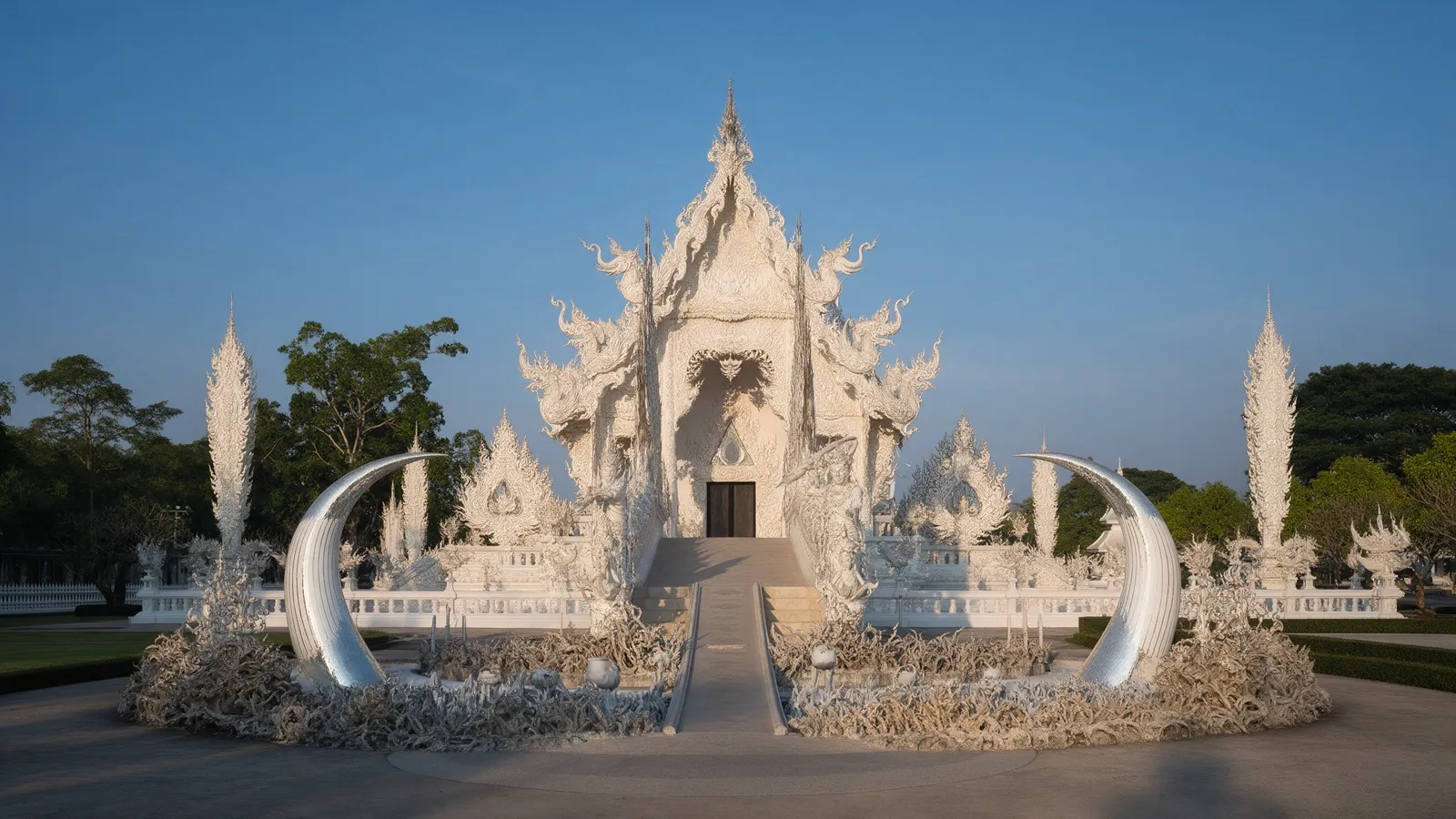
The “White Temple” is the work of the artist Chalermchai Kositpipat, who has been building it for years with a large team. The white walls are covered with small pieces of mirror, along with nagas, elephants and figures from Thai mythology. The temple lies about 13 to 15 kilometres south of the city, is open daily from 8:00 to 17:30 (last entry around 17:00) and has cost 200 baht for foreign visitors since 2026. Admission is free from the age of 70; you should bring ID for this.
Wat Rong Suea Ten
The “Blue Temple” is closer to the city. Inside and out, everything is in deep blue and gold. It costs nothing to enter and is open daily from 7:00 to 20:00. It is less crowded than the White Temple.
Baan Dam
The “Black House” of the artist Thawan Duchanee is the counterpart to the White Temple: dark wooden houses full of horns, hides and bones. Admission costs 80 baht, and it is open daily from 9:00 to 17:00. It may close at midday between 12:00 and 13:00, so check on site.
Wat Huay Pla Kang
Here stands a white statue of the goddess Guanyin, around 79 metres tall. The grounds are open daily from 7:00 to 21:00, and admission costs 40 baht. From 7:00 to 18:00 a lift inside the statue takes you up, and from the top you look out over the city.
Wat Phra Kaeo
In 1436 the Emerald Buddha, which now stands in the Grand Palace in Bangkok, was discovered in the chedi of this temple in the city. Also worth seeing are the Lanna-style Wat Phra Sing and Wat Phrathat Doi Chom Thong, the oldest temple in the city, with a view of the Kok.
Golden Triangle
In the district of Chiang Saen, about an hour’s drive north, the viewpoint looks out across the Mekong to Laos and Myanmar. There are boat trips on the river, and in the “Hall of Opium” you learn how opium poppy cultivation shaped the area. The old town of Chiang Saen with remains of walls and temple ruins lies right next to it.
Chiang Rai: guided tour to the Golden Triangle and 7 sights
Full-day tour from Chiang Rai to the Golden Triangle and seven sights, in a small group.
- Full day
- Guide in English
- Free cancellation up to 24 hours in advance
from €38 per personAs of 21 October 2026
 Check availability
Doi Tung
Here the grandmother of the current king had her residence built, a mix of a northern Thai house and a Swiss chalet. You can visit the Doi Tung Royal Villa, and right next to it lies the Mae Fah Luang Garden with flower and rock gardens. A combined ticket for villa, garden and exhibition costs 220 baht, half price from the age of 60.
Doi Mae Salong
The village of Santi Khiri was founded by former Chinese soldiers. Tea, coffee and fruit grow all around. It is most beautiful in December and January, when the cherry trees bloom. Try the Yunnan cuisine here.
Phu Chi Fah
From this mountain you can see as far as Laos. In the cool winter months there is often mist in the valleys at sunrise.

Chiang Mai: White, Blue and Red Temple in Chiang Rai and Karen village
Day trip starting in Chiang Mai: the White, Blue and Red Temple in Chiang Rai, plus a visit to a Karen village.
- 12 to 13.5 hours
- Guide in English and Spanish
- Free cancellation up to 24 hours in advance
from €32 per personAs of 21 October 2026
Check availabilityTips for travellers aged 50 and over
In the White Temple, shoulders and knees must be covered, and in the main building you take your shoes off and photography is not allowed. It is best to come early in the morning, before 9:30. Then it is cooler and there are fewer groups. At midday it gets hot, and the glare off the white surfaces is intense. I would take sunglasses and water.
The path to the main building is mostly paved and almost level, and only the bridge rises slightly. It is different at Wat Phrathat Chom Kitti near Chiang Saen: there, more than 300 steps lead up.
For trips into the mountains, it is best to take a driver or an organised tour. In Thailand there are many fatal road accidents, and 70 percent of the victims are on two-wheelers. For sunrise at Phu Chi Fah you also need a jacket.
Keep an eye on air quality. In the dry season from November to April there is more smoke and dust from fires, even in the countryside. It is usually worst from February to April. You can find the current readings at the World Air Quality Index or Air4Thai, for example. If you have problems with your airways or heart, talk to your doctor before the trip.
On a boat trip on the Kok I would not go into the water. The river is contaminated with arsenic from mining in Myanmar, and more than twice the Thai limit was measured (April 2026).
For emergencies there are several private hospitals with English-speaking staff, including Bangkok Hospital Chiang Rai with an emergency department open around the clock.
In the Golden Triangle border region there is considerable crime, above all drug and human trafficking. Stick to the usual viewpoints and boat trips, and do not take up offers from strangers. At present, foreign tourists generally cannot cross the border into Myanmar at Mae Sai at all (as of September 2026). I would skip going there on your own.
Best time to visit
The weather is similar to Chiang Mai. According to the long-term averages of the Chiang Rai weather station, it hardly rains from November to February, and it is warm by day and cool at night. In March and April it gets very hot, and smoke often hangs in the air. July and August are the wettest. You can see all the monthly values on the weather page for Chiang Rai.
What you need before you fly is covered in Entering Thailand in 2026. What a day there roughly costs is covered in Costs in Thailand per day.
Comparison
Not sure whether this place is the right one? Here are the differences side by side: