
Guide
Shopping in Thailand: Souvenirs, VAT Refund and Customs on the Way Home
Markets, malls and haggling in Thailand, plus the VAT refund from 2,000 baht, export bans on Buddha images and coral, and customs rules for DE, AT and CH.
- Category: Daily life
- 13 min read
- Updated:26 October 202626/10/2026
Contents of this article10 sections
- Where to shop: markets, malls and night bazaars
- Haggling: how to do it without a row
- Typical souvenirs
- VAT refund: getting the VAT back as a tourist
- What you may not take out of Thailand
- Back home: what you may bring in duty-free
- Medicines, food and plants
- Species protection: what you may take without documents
- Luggage and weight
- Frequently asked questions
Shopping at Thailand’s markets and in its malls is fun, and a lot of it costs less than at home. The trouble usually comes at the end: at the VAT counter, on departure, or at customs in Frankfurt, Vienna or Zurich. As of October 2026.
In brief
- You get VAT (7 percent) back if you spend at least 2,000 baht per day and per shop, have the P.P.10 form issued with your passport, and take the goods out of the country within 60 days.
- For goods worth 20,000 baht or more, you must show them to customs before check-in. So do not pack them in your suitcase.
- Buddha images and antiques need an export permit from the Fine Arts Department.
- Coral, shells, ivory and crocodile, snake or elephant leather are a matter for species protection. Traders are not authorised to issue you a valid export certificate.
- On flights to Germany and Austria you may bring in goods worth up to 430 euros free of duty, and into Switzerland up to 150 francs.
Where to shop: markets, malls and night bazaars
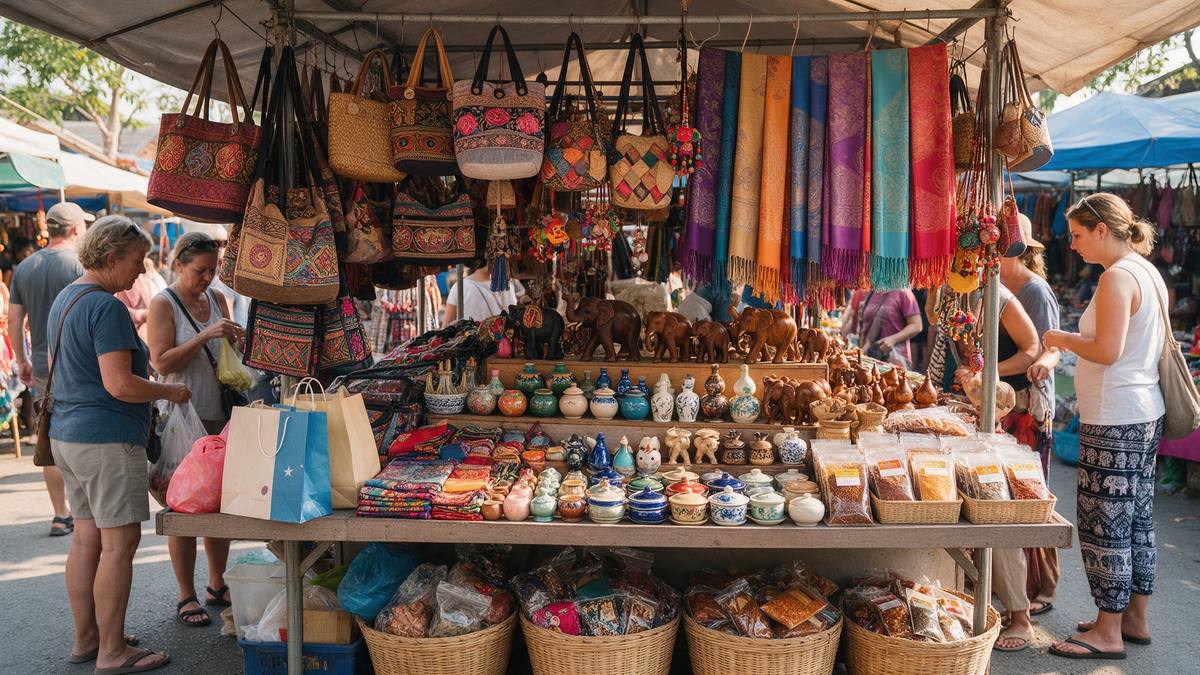
Markets and night bazaars are the place for souvenirs, clothing and handicrafts. In Bangkok, Chatuchak Weekend Market is open on Saturday and Sunday from 9 am to 6 pm, with more than 15,000 stalls. Come early, because by midday it gets hot and crowded. Night markets such as those in Chiang Mai also live on haggling. Small notes help, because large ones make getting change awkward when you haggle.
Malls have fixed prices. They sell brands, electronics and cosmetics, plus air conditioning and card payment. Bangkok has them in large numbers. Shops with the sign “VAT REFUND FOR TOURISTS” take part in the VAT refund. Haggling is not usual here.
How you pay in Thailand otherwise and what cards cost at ATMs is covered in the guide Money and Payments in Thailand.
Haggling: how to do it without a row
At markets and with street vendors, the first price is an offer. The usual approach is to start a little below it, in a friendly way, and meet in the middle. There are no fixed percentages, it depends on the goods and the mood.
- Smile and stay calm. Whoever gets loud loses.
- Only name a price when you really want to buy. Turning down a deal after haggling goes down badly.
- Buy several items at one stall, then you are more likely to get a bundle at a good price.
- Show interest and walk a few steps away. Often a better offer follows.
- In shops with marked prices and in malls you do not haggle.
How to spot tricks where tuk-tuk drivers take tourists to overpriced shops is explained in the guide Scams and Safety in Thailand. Do not buy anything expensive on a driver’s recommendation.
Typical souvenirs
What makes a good gift is light, durable and not protected:
- Silk and cotton: scarves, shirts, cushion covers
- Handicrafts from the north: wood carvings, ceramics, umbrellas, wickerwork
- Silver jewellery from traders with price tags (no ivory, no tortoiseshell)
- Spice pastes, tea and coffee in small quantities
- Coconut oil, herbal balm and soaps from pharmacies or drugstores
- Clothes for the beach and the market that you will wear anyway
Plan what you buy with the journey home in mind. Not everything may go on the plane or across the border.
VAT refund: getting the VAT back as a tourist
VAT in Thailand is 7 percent. As a tourist you get it back when you leave, if you meet these conditions:
- You are neither a Thai national nor resident in Thailand. Airline crew members on duty are excluded.
- You buy in shops with the sign “VAT REFUND FOR TOURISTS”.
- You spend at least 2,000 baht including VAT per day and per shop, which at a rate of about 37.8 baht to the euro is around 53 euros.
- You leave via an international airport and take the goods with you.
- No more than 60 days pass between the purchase and your departure. The day of purchase counts as the first day.
How it works
- In the shop: Show your passport and have the P.P.10 form (or the digital version e-P.P.10) issued together with the original invoice. Check that the name and passport number are correct. If the form is missing on the day of purchase, nothing is refunded.
- At the airport, before check-in: If the value of the goods is under 20,000 baht per person, there is no customs check. At 20,000 baht or more, you show the goods, the P.P.10 and the original invoices at the “Customs Inspection for VAT Refund” counter and get a stamp.
- Luxury goods: After passport control, you take jewellery, watches, glasses, fountain pens, mobile phones, laptops, tablets, handbags, wallets and belts worth 40,000 baht or more per item, as well as any goods worth 100,000 baht or more per item, to the “VAT Refund for Tourist Office” once more.
- After passport control: You hand in stamped forms at the office. Without luxury goods, dropping them in the box in front of it is enough.
- Payout: Refunds of up to 30,000 baht are paid in cash, to a card or through the VRT app on WeChat and Alipay. Anything above that is paid to a card only.
There are also refund points in the city (Downtown VAT Refund) paying up to 12,000 baht in cash. In that case you must take the goods out of the country within 14 days and still hand in the documents at the airport, otherwise the amount is reclaimed.
Allow plenty of time at the airport. The counter will tell you the exact payout. I have not checked possible deductions.
What you may not take out of Thailand
Buddha images and antiques. Buddha images and Buddha pictures may only be exported from Thailand with permission from the Fine Arts Department. For antiques and art objects, this applies whether or not they are registered. Practical reports suggest that even new souvenir figures can fall under it, although small pieces often go unnoticed in everyday life. Do not rely on that; ask the trader how the permit works instead. If he cannot explain it, leave the figure in the shop.
Protected animals and plants. Ivory and leather from elephant, crocodile or snake are subject to species protection and as a rule need permits. The same applies to things that tourists often do not recognise as protected: coral, mussel and snail shells, tortoiseshell from sea turtles, stuffed birds, monkey products and orchids.
Do not let traders talk away your concerns by offering you their own “export certificate”. Only the authorities of the holiday country can issue an official permit.
Counterfeit branded goods. Counterfeit branded goods and pirated copies are on the Thai customs list of prohibited goods. Importing them into Germany risks confiscation and destruction, possibly criminal proceedings. Customs steps in when there is a suspicion of commercial import, for example because of the type and quantity of the goods. The value limits play no role here. Imitations are risky for a second reason: in tourist places, corrupt police officers sometimes accuse holidaymakers of petty offences such as stealing imitation watches in order to extort money.
Back home: what you may bring in duty-free
What counts is your country of residence. The allowances apply to goods in your luggage that you bring for yourself or as a gift, never for sale.
| Germany | Austria | Switzerland | |
|---|---|---|---|
| Other goods, air travel | up to 430 euros | up to 430 euros | up to 150 francs, above that VAT |
| Cigarettes (from age 17) | 200 | 200 | 250 (including cigars) |
| Spirits over 22 % (Switzerland: over 18 %) | 1 litre | 1 litre | 1 litre |
| Weaker drinks | 2 litres, plus 4 litres of wine and 16 litres of beer | 2 litres, plus 4 litres of wine and 16 litres of beer | 5 litres (up to 18 %) |
What you should know:
- The value limits of several people are not added together. In Germany, the value of the goods counts including foreign sales tax. For children under 15, the limit is lower (Germany 175 euros, Austria 150 euros).
- Indivisible goods such as a leather jacket or a piece of jewellery are charged duty on the total value if the limit is exceeded, not only on the amount above it.
- Only goods you carry count. Luggage that you send ahead or afterwards, or parcels sent by post, do not fall under the travel allowances. The exceptions for species protection also do not apply to postal items.
- Declare it if it is more. If you are over the limit, you go through the exit for goods to declare. Swiss residents can declare their goods in advance with the QuickZoll app.
- Cash of 10,000 euros or more must be declared when you enter Germany.
- Customs can change limits and rules. Check your customs website before you travel home.
Medicines, food and plants
Medicines. You may bring in medicines in the quantity you personally need. Anything covered by narcotics law may only be brought into Germany with a doctor’s certificate. Austria allows medicines bought abroad without a permit only up to three retail packs per person. Food supplements can count as medicines depending on how they are presented. The Thai rules for bringing in medicines are in the packing list for Thailand.
Food. Private import is generally permitted, but with exceptions:
- Meat, sausage, dairy products and eggs are subject to further restrictions for animal disease reasons. Switzerland bans animal products from Thailand completely, including meat and butter.
- EU protective measures apply to some plant-based foods from certain countries, such as tea, spices or sesame. Small quantities for personal use of up to 2 kilograms are exempt, and up to 5 kilograms for fresh produce.
- Fresh fruit, plants, plant parts and seeds are subject to plant health law. Pineapple, coconut, durian, banana and dates are exempt from this. Other fruit such as mango or rambutan falls under the stricter plant health rules and is better left in Thailand. Switzerland bans most fruit and vegetables from third countries.
Austria, as an EU country, has the same basic rules. If in doubt, ask the customs office.
Species protection: what you may take without documents
German customs names exceptions for travellers where dead specimens of certain species are allowed in luggage without papers. Per person:
- up to three specimens of giant clams, no more than 3 kilograms in total
- up to four crocodile leather items
- up to four seahorses
- Agarwood (eaglewood): up to 1 kilogram of chips, 24 millilitres of oil and two strings of beads
This is not an invitation to collect on the beach or buy everything. The exceptions concern import into the EU. Whether you may export the goods from Thailand is a separate question. Ivory, tortoiseshell and rhino products generally need papers. Postal items are excluded.
Luggage and weight
Markets tempt you to buy. Do the sums before the flight home:
- Your free baggage allowance is shown in your ticket and differs by airline and fare. Check beforehand whether an extra bag is cheaper than excess baggage at the counter.
- Fragile items such as ceramics should go, well padded, in your hand luggage or in the middle of the suitcase.
- Goods worth 20,000 baht or more for which you want the VAT back stay within reach until the customs check.
- Parcels can be shipped, but they then do not fall under the travel allowances.
What belongs in the suitcase and what stays at home is in the packing list for Thailand. What else is banned in Thailand, from e-cigarettes to drones, is shown in the guide Banned in Thailand.
Frequently asked questions
How much VAT do I get back in Thailand?
VAT is 7 percent. You get it refunded when you leave if you spend at least 2,000 baht in one day in a participating shop, have the P.P.10 form issued with your passport and take the goods out of the country within 60 days. The counter will tell you the exact payout.
Do I have to show my purchases for the VAT refund?
From a total value of 20,000 baht per person, yes, before check-in at the customs counter for VAT refund. Below that, the check does not apply. You show luxury goods worth 40,000 baht or more per item once more after passport control at the VAT Refund Office.
May I take a Buddha image out of Thailand?
Only with permission from the Fine Arts Department. Buddha images and Buddha pictures are expressly subject to permission. Ask the trader how the permit works, and if in doubt do not buy anything you may not legally export.
May I take shells and coral from the beach or market?
Coral as well as mussel and snail shells can fall under species protection. Exceptions apply for individual species, for example up to three giant clams of no more than 3 kilograms per person on entry into the EU. If in doubt, leave everything where it is. An export certificate from the trader is worthless.
How much may I bring to Germany, Austria or Switzerland?
Air travellers may import goods worth up to 430 euros duty-free into Germany and Austria, plus 200 cigarettes and 1 litre of spirits. In Switzerland, VAT is due from a goods value of 150 francs. You may not bring meat and dairy products into Switzerland.