
Guide
BTS Skytrain and Trains in Bangkok: Tickets, Lines and Transfers for Tourists
Skytrain, MRT, Airport Rail Link and Red Line in Bangkok: 2026 fares, Rabbit Card, credit card at the gate, interchange stations, times and typical mistakes.
- Category: Daily life
- 16 min read
- Updated:26 October 202626/10/2026
Contents of this article12 sections
- The network at a glance
- Changing trains: the stations you should know
- Tickets and paying: what works on which line
- What a trip costs (as of October 2026)
- Operating hours and rush hours
- Which stop for which destination
- From the airport into the city
- BTS or taxi and Grab
- Behaviour on the train
- Typical pitfalls
- Luggage and accessibility
- Frequently asked questions
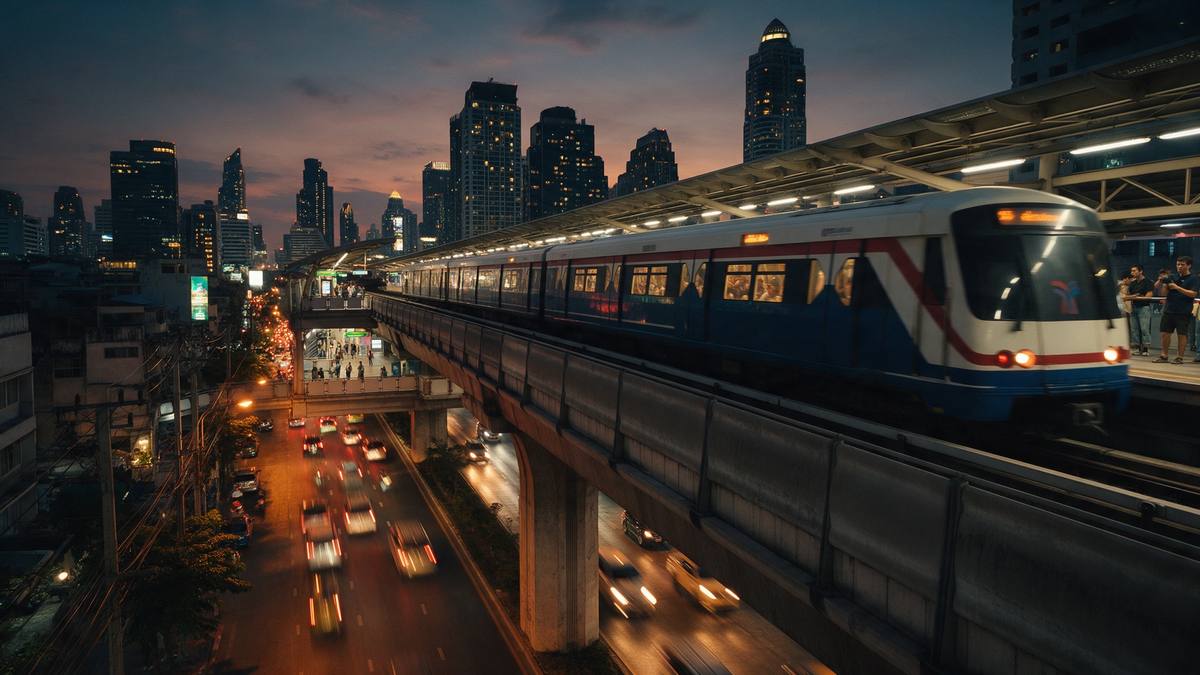
In Bangkok, taking the train mostly spares your nerves. The traffic stays down below while you ride above or beneath it in air-conditioned comfort. The catch: the network belongs to several operators, and each has its own ticketing system.
In short
- The Skytrain (BTS) has two lines that cross at Siam: the Sukhumvit Line and the Silom Line. There is also the short Gold Line to ICONSIAM.
- You can get through the gate with a credit card on the MRT Blue Line, the Airport Rail Link and the Red Line. Not on the BTS: there you need a single-journey ticket or a Rabbit Card.
- A BTS single-journey ticket costs 17 to 47 baht in the core network, and the MRT Blue Line has cost 17 to 44 baht since 3 July 2026.
- Every change between BTS, MRT, Airport Rail Link and Red Line means: out through one gate, in through another, new fare.
The network at a glance
BTS Sukhumvit Line. From Khu Khot in the north via Mo Chit, Siam, Asok and Phrom Phong to Kheha in the south-east. Most tourists only travel between Mo Chit and Phrom Phong.
BTS Silom Line. From National Stadium via Siam, Sala Daeng and Saphan Taksin to Bang Wa. It takes you to Silom, Sathorn and the boat on the river.
Gold Line. A short shuttle line with three stations: Krung Thon Buri, Charoen Nakhon and Khlong San, where you get off for ICONSIAM. It has its own fare.
MRT Blue Line. The underground runs a big loop around the city centre, with stops at Sukhumvit, Si Lom, Chinatown (Wat Mangkon), Wat Pho (Sanam Chai) and Chatuchak Park. The Purple Line goes to Nonthaburi, and the Pink and Yellow Lines are monorails in the suburbs.
Airport Rail Link (ARL). It connects Suvarnabhumi Airport with Phaya Thai and stops at eight stations. There is no longer an express train, and older guidebooks are wrong on this.
SRT Red Line. The Dark Red Line runs from Krung Thep Aphiwat via Chatuchak to Don Mueang and on to Rangsit. For you, the stop at Don Mueang Airport matters most.
A joint fare across all lines is planned for 2027, but the details are not yet fixed. Until then: one ticket per operator.
Changing trains: the stations you should know
Between the networks you walk short corridors or skywalks, and a change always goes through an exit gate and an entry gate.
- Siam: BTS Sukhumvit and BTS Silom. Both lines belong to the same operator, and you change on the platform without a gate.
- Asok: BTS Sukhumvit and MRT station Sukhumvit, connected by a covered walkway.
- Sala Daeng: BTS Silom and MRT station Si Lom.
- Mo Chit: BTS Sukhumvit and MRT station Chatuchak Park, both at the Chatuchak Market.
- Phaya Thai: Airport Rail Link and BTS Sukhumvit.
- Makkasan: Airport Rail Link and MRT Blue Line (station Phetchaburi).
- Saphan Taksin: BTS Silom and the Sathorn pier for the express boats on the Chao Phraya.
- Krung Thon Buri: BTS Silom and Gold Line.
- Krung Thep Aphiwat: Red Line and MRT Blue Line, where the MRT station is called Bang Sue.
At Phaya Thai and Makkasan you have to use stairs and escalators. With several large bags this gets tiresome.
Tickets and paying: what works on which line
This changed several times in 2025 and 2026, and older blogs are often wrong.
| Line | Credit card at the gate | Rabbit Card | Otherwise |
|---|---|---|---|
| BTS (Sukhumvit, Silom) | No | Yes | Single-journey ticket |
| Gold Line | No | Yes | Single-journey ticket |
| MRT Blue and Purple | Yes (Visa, Mastercard, UnionPay) | No | Single-journey ticket (token) |
| Airport Rail Link | Yes, since 8 November 2025 | No | Single-journey ticket at the station |
| SRT Red Line | Yes | No | Single-journey ticket |
On the suburban Pink and Yellow monorails, bank cards and the Rabbit Card both work.
BTS: single-journey ticket or Rabbit Card. At the machine you tap your destination on the route map, the price appears, then you pay. There are two types of machine: the simple ones take only coins (1, 2, 5, 10 baht). The larger ones also take notes (20, 50, 100, 500 baht) and QR payment via mobile banking, Alipay or WeChat. Whether a German banking app works is not documented, so have cash with you. The single-journey ticket is only valid on the day of purchase.
The Rabbit Card is the BTS stored-value card. The standard card costs 200 baht: a 120 baht issue fee and 80 baht starting credit. There is no deposit, and you do not get the fee back. You can top up from 100 baht at the counters and at the machines, where only notes are accepted. It is not worth it for two or three trips, but for daily travel it saves you queuing at the machine. It does not work on the MRT Blue Line, the Airport Rail Link or the Red Line.
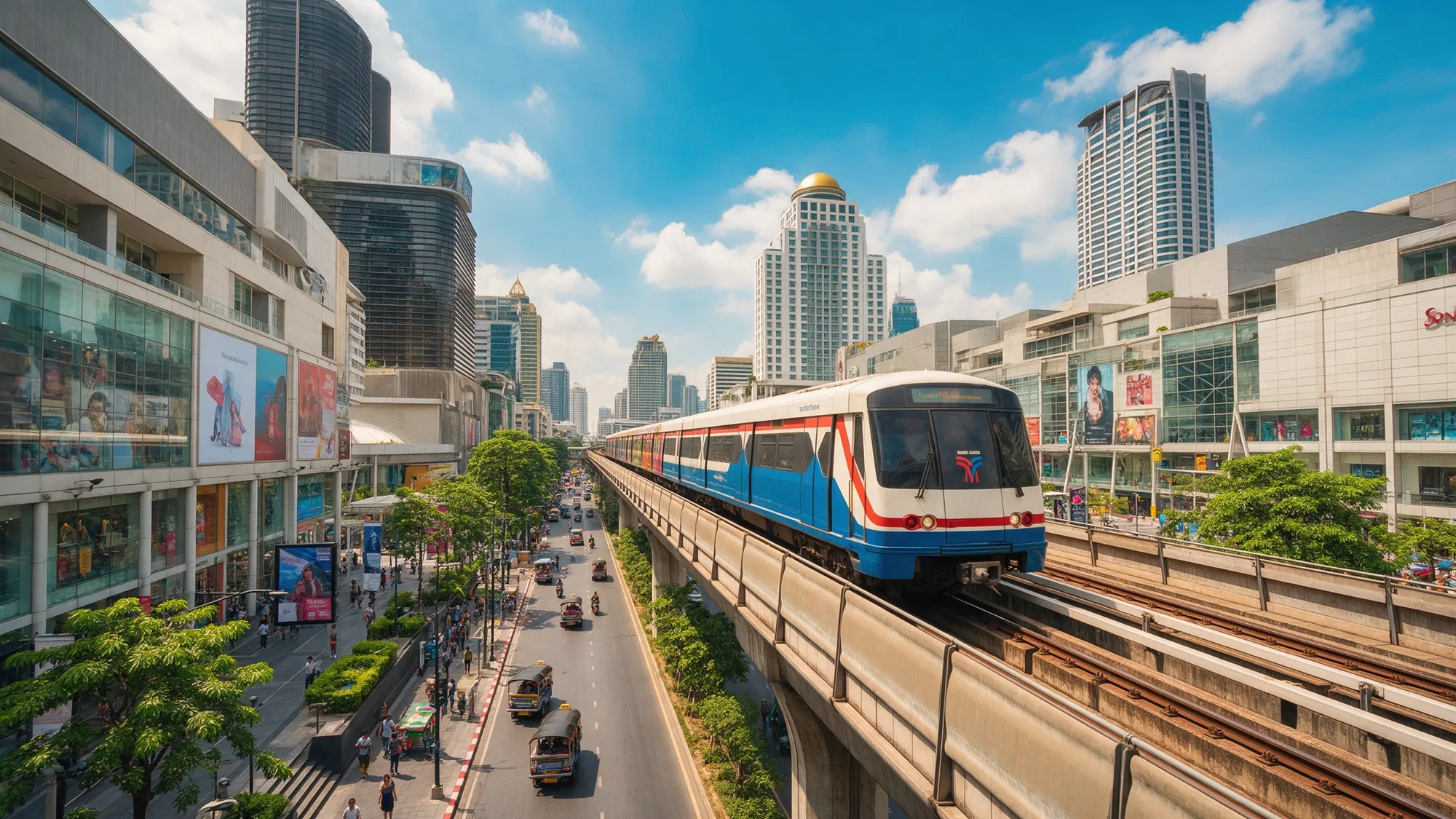
The official BTS One-Day Pass costs 150 baht and is valid only on the day of issue on the BTS Green Line. You buy it at the BTS counters, and the Gold Line is not included. With fares of around 30 baht, it roughly pays off from five trips a day. If you prefer to book in advance, you can also buy the day ticket through a provider and collect it at the airport. Such an offer is listed at Trip.com. From €3.98, as of 26 October 2026.
MRT: tap your card. On the Blue and Purple Lines you hold a contactless Visa, Mastercard or UnionPay card to the reader, and the same card again when you leave. The old MRT stored-value cards stopped working on 1 June 2026. Foreign credit cards are allowed. For debit cards, BEM only lists cards from Thai banks, so a German debit card may not work.
Airport Rail Link and Red Line: here too you tap your card. On the Airport Rail Link this has been possible since 8 November 2025, and single-journey tickets are still sold at the station.
What a trip costs (as of October 2026)
- BTS single-journey ticket: 17 to 47 baht in the core network. On sections of the extensions it is 15 baht, and for journeys through the core network out to the outer sections it is up to 62 baht. The table is from January 2024, and the machine shows the current fare.
- Gold Line: a flat 17 baht.
- MRT Blue Line: 17 to 44 baht, and from twelve stations the maximum fare applies.
- Airport Rail Link: 15 to 45 baht, and Phaya Thai costs 45 baht.
- Red Line: 12 to 42 baht, and from Krung Thep Aphiwat to Don Mueang it is 33 baht.
Children travel free depending on the line: on the BTS and Gold Line up to 90 centimetres in height, on the MRT Blue Line up to 120 centimetres. How train journeys fit into the daily budget is in the guide Costs in Thailand per day.
Operating hours and rush hours
BTS stations are open from 5 am to 1 am. The last train from Siam leaves at 12:02 am and stops at every station. The 12:15 am train only runs as far as the terminal stations. The ticket counters are open from 6:00 to midnight, and after that you can neither buy tickets nor top up there. Buy your ticket in good time.
The Airport Rail Link runs from 5:30 to midnight, and the Red Line from 5:00 until about midnight. The MRT runs roughly from 6:00 to midnight.
It gets crowded from about 7:00 to 9:00 and from 17:00 to 20:00, especially at Siam, Asok and Sala Daeng.
Which stop for which destination
- Siam: Siam Paragon, CentralWorld and the shopping centres.
- National Stadium: the Jim Thompson House, a short walk away.
- Mo Chit (BTS) or Chatuchak Park (MRT): the Chatuchak Weekend Market, fully open on Saturdays and Sundays from 9:00 to 18:00.
- Saphan Taksin: change to the express boat at Sathorn Pier. From there it goes to the Tha Chang and Tha Tien piers for the Grand Palace, Wat Pho and Wat Arun. The orange line ticket costs around 19 baht.
- Sanam Chai (MRT): Wat Pho right on the doorstep.
- Wat Mangkon (MRT): Chinatown and Yaowarat Road.
- Nana and Asok: Sukhumvit Road, with Terminal 21 at Asok. Around Nana there are also red-light areas.
- Sala Daeng: Silom and Lumphini Park.
- Krung Thon Buri: the Gold Line to ICONSIAM.
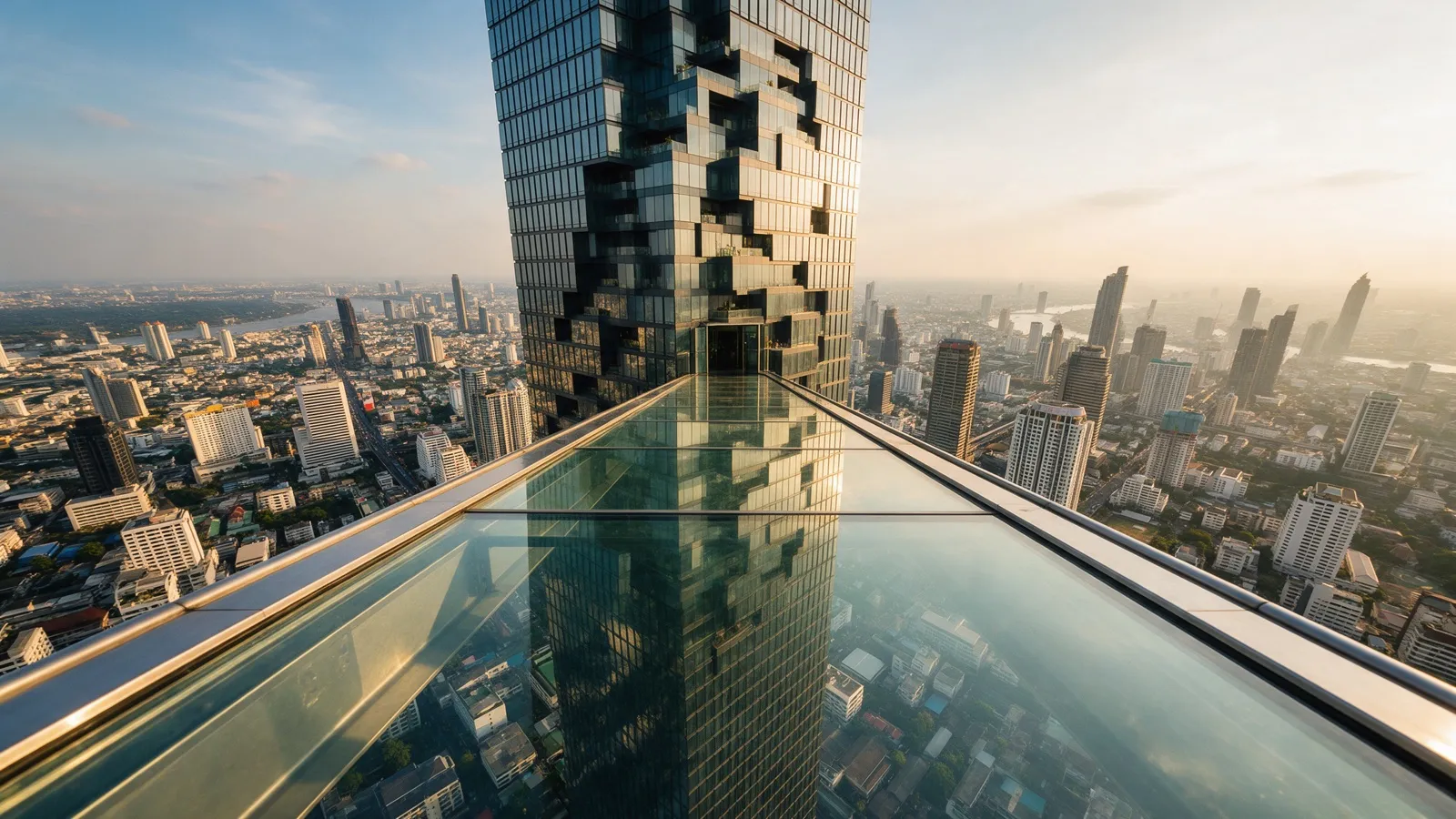
The glass floor on the 78th floor is at a height of 310 metres, and BTS Chong Nonsi station (exit 3) is right next door. It is open daily from 10:00 to midnight, with last admission at 23:00. It is best to book the time slot for the glass floor on Trip.com in advance, for example for late afternoon.
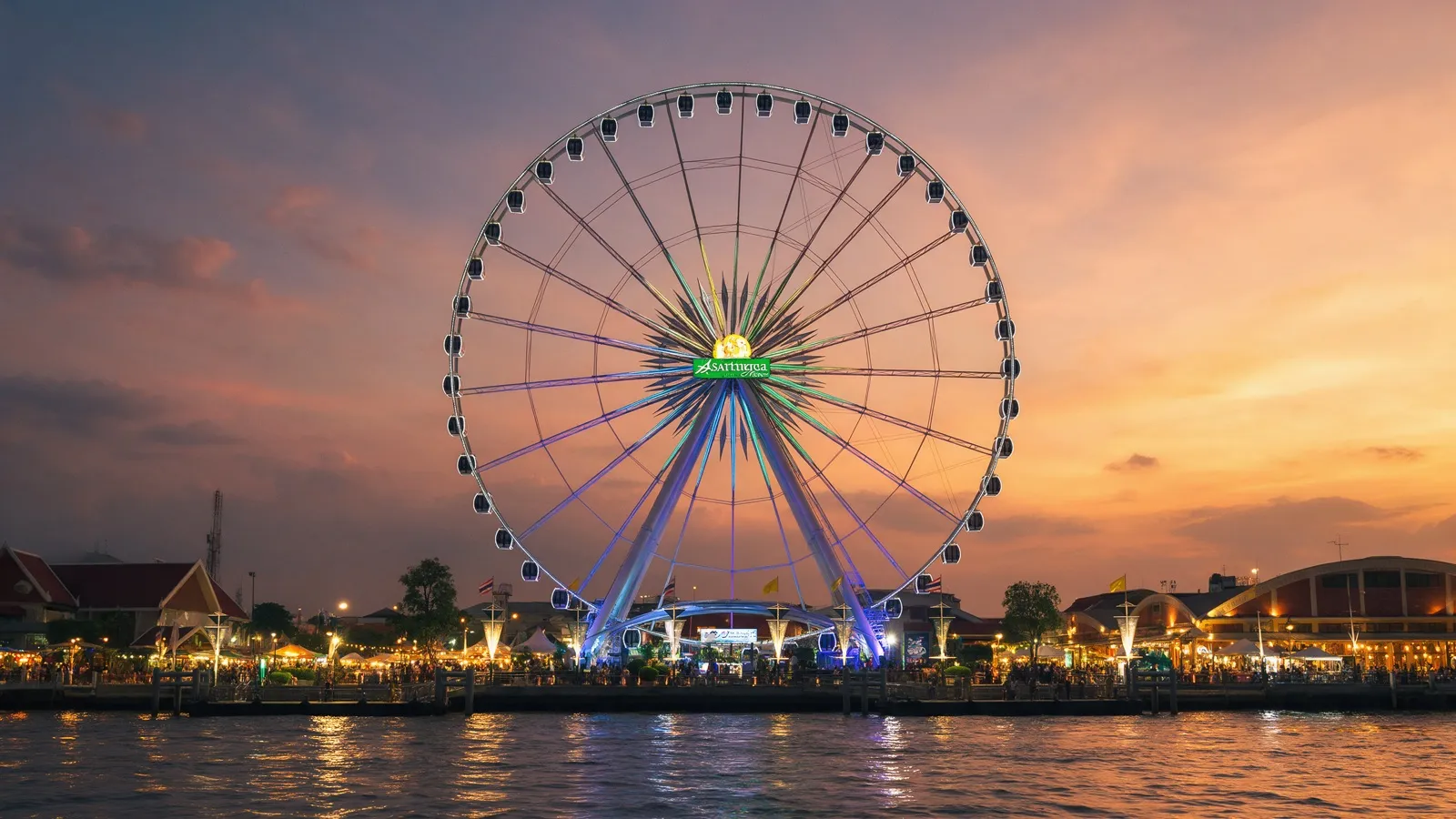
To get to Asiatique on the riverfront, you take the BTS to Saphan Taksin and then the free shuttle boat. There you ride the Skyflyers more than 100 metres above the Chao Phraya (minimum height 120 cm), and time slots and height requirements are listed on Trip.com.
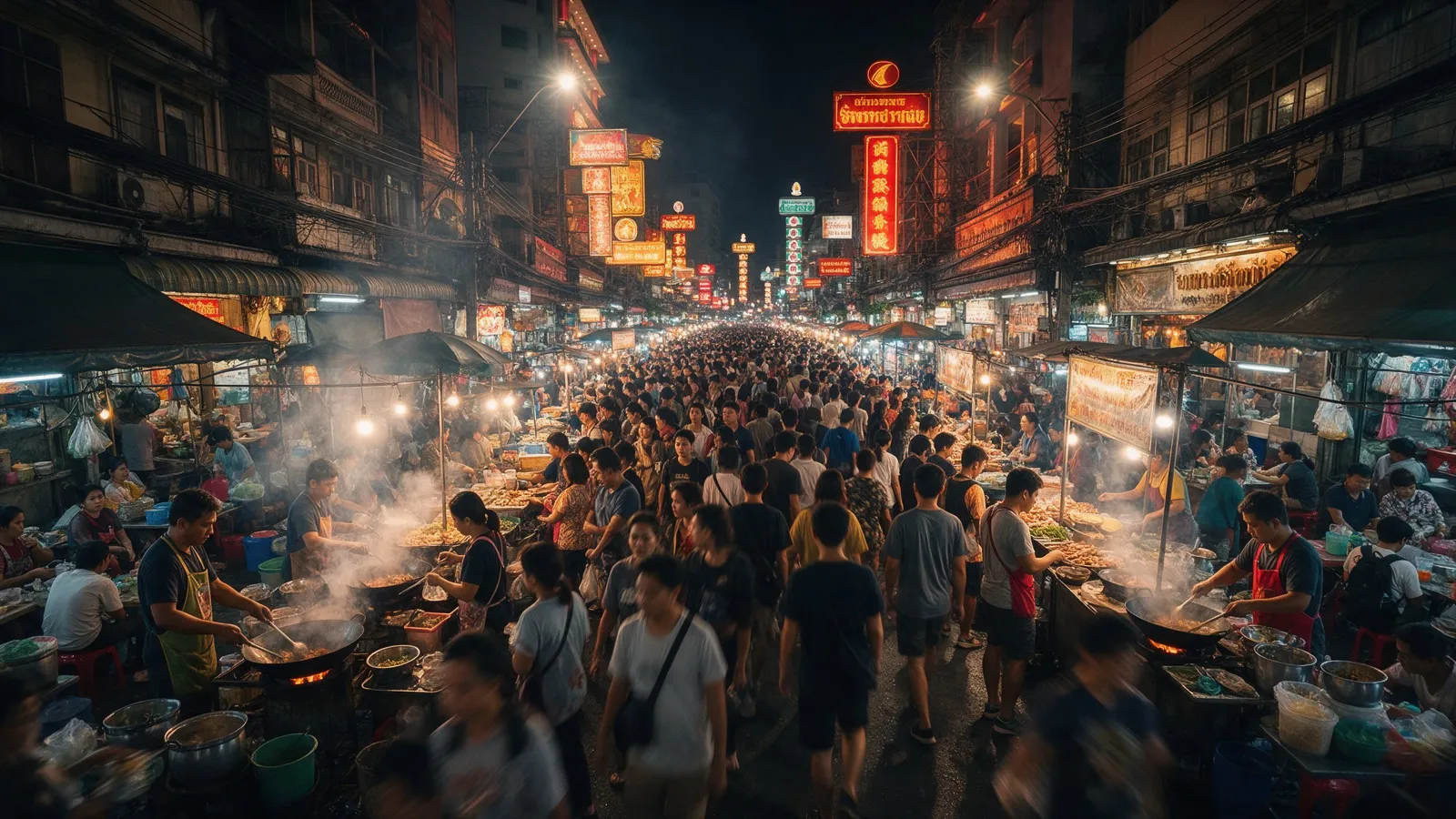
You do not need a ticket for Chinatown, as you can take the MRT Blue Line to Wat Mangkon station. The food stalls open from about 17:00 to 18:00, it is busiest from 19:00 to 21:00, and many are closed on Mondays. Food tours and guided evening walks are available on Trip.com.
Where you should stay is covered on the page about Bangkok.
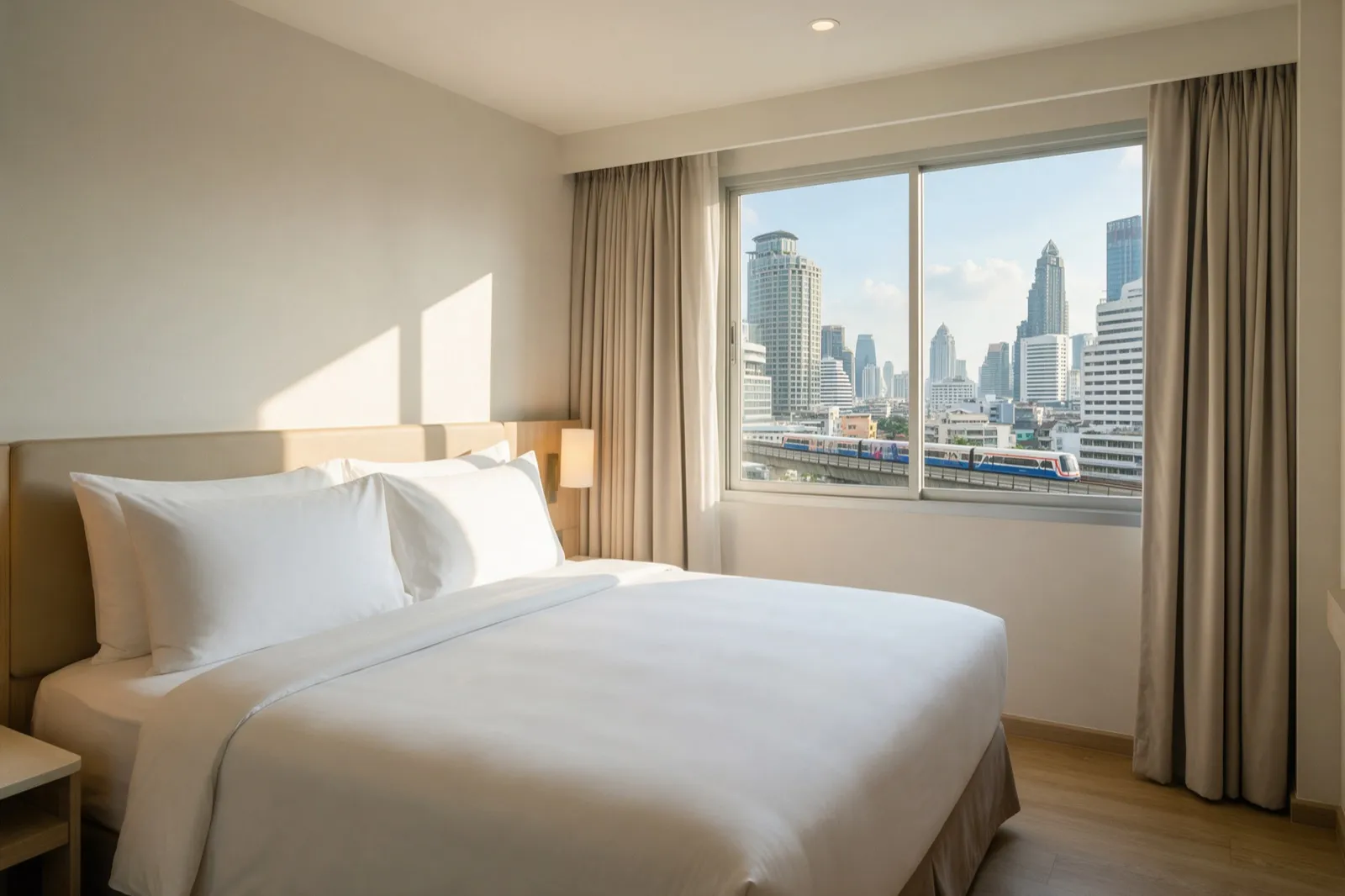
If you travel by Skytrain, you save time if your hotel is close to a station, ideally in Siam, Silom or on Sukhumvit. You will find a selection of hotels in Bangkok at Trip.com.
From the airport into the city
Suvarnabhumi (BKK): The Airport Rail Link departs from the lower level and takes about 26 to 30 minutes to Phaya Thai. Which station you choose depends on your hotel:
- Sukhumvit or Silom: get off at Makkasan, then take the MRT.
- Siam and the shopping centres: to Phaya Thai, then the BTS towards Siam.
- Pratunam: Ratchaprarop.
- Chatuchak or Ari: Phaya Thai, then the BTS northwards.
If you land after about 22:30, you may not make the train before midnight. Plan on a taxi or Grab then. There is hardly any room for luggage on the train, and at rush hour it is full. With a large suitcase, a taxi is often better, and the fares are in the guide Getting around in Thailand.
Don Mueang (DMK): From the terminal you walk over a skywalk to Don Mueang station. The Red Line takes you to Krung Thep Aphiwat for 33 baht, where you continue on the MRT Blue Line. The first train leaves at 5:00. How to tell the two airports apart is in the guide Flying to Thailand cheaply.
BTS or taxi and Grab
When it rains, a car easily takes twice to three times as long for the same route, while the train carries on unaffected.
A taxi or Grab is better if
- you have a lot of luggage or heavy luggage,
- you are travelling late at night when the trains have stopped,
- your destination is far from any station, such as Khao San Road.
Take a taxi with a meter or a ride-hailing app with a fixed price, and with tuk-tuks you agree the price beforehand.
Behaviour on the train
- Eating and drinking: Both are banned on trains and in the paid area of the stations, including water. Drink before you board.
- Alcohol and smoking: Drinking alcohol is banned in the system. Smoking is prohibited in all public areas and costs up to 2,000 baht, as do littering and spitting.
- Priority seats: The marked seats are for pregnant women, older people, small children and monks. Women do not touch monks, so leave some distance.
- Boarding: Stand to the side of the door and let people get off first.
- Noise: Loud music without headphones is a nuisance, and singing and playing music are banned without permission.
- Clothing: The air conditioning is cold, and a thin jacket helps.
Typical pitfalls
Ticket lost, fine due. You need the ticket to exit. Anyone who loses it or stays in the station too long pays the maximum fare. On the BTS the time limit in the paid area is 300 minutes.
Phone instead of card. The phone is not always recognised at the gates, and the plastic card is more reliable.
Rabbit Card on the wrong line. It does not work on the MRT Blue Line, the Airport Rail Link or the Red Line. Anyone who forgets this needs a second ticket.
Too late at the counter. The BTS counters close at midnight. If you still want to travel after that, you need a card or ticket beforehand.
Strangers helping at the machine. Anyone who offers help with tickets or luggage unasked usually wants to earn something. The BTS regulations prohibit this. Stay polite and decline.
The palace scam. If someone approaches you and claims the palace is closed today, it is a trick for an overpriced tuk-tuk tour. More on this in the guide Scams and safety in Thailand.
Luggage and accessibility
The BTS has wide gates with a 90 centimetre opening for wheelchairs and luggage. Luggage that obstructs others is not allowed.
People with disabilities are exempt from fares on the BTS. On the Gold Line and MRT Blue Line this applies with a Thai disability card. Whether your card from Germany, Austria or Switzerland is recognised has not been clarified, so ask at the counter.
Frequently asked questions
Can I pay by credit card on the BTS Skytrain?
No, not as of October 2026. You need a single-journey ticket, a Rabbit Card or a One-Day Pass. A contactless credit card does work on the MRT Blue Line, the Airport Rail Link and the Red Line.
Do I need a Rabbit Card as a tourist?
Not necessarily. For a few trips, single-journey tickets are enough. The card costs 200 baht, of which 120 is the fee and 80 is credit, and you top up from 100 baht. It is not valid on the MRT Blue Line and the Airport Rail Link.
How do I get from Suvarnabhumi Airport into the city?
By Airport Rail Link in about 26 to 30 minutes to Phaya Thai, where you change to the BTS, or at Makkasan to the MRT. If you land after about 22:30, take a taxi or Grab.
Until when does the Skytrain run?
The last train from Siam leaves at 12:02 am and stops at every station, and the 12:15 am train runs as far as the terminal stations. The counters close at midnight.
Am I allowed to eat and drink on the train?
No, not even water. This applies on the trains and in the paid area of the BTS stations.