
Guide
Accommodation in Thailand: Hotel, Hostel or Bungalow, and What Does a Night Cost?
Hostel, guesthouse, hotel, bungalow or Airbnb: prices per night, seasonal surcharges, location tips, TM30, passport copy, deposit and typical traps.
- Category: Costs
- 13 min read
- Updated:25 October 202625/10/2026
Contents of this article9 sections
Accommodation is the biggest item in a Thailand budget, and the range is huge. A bed in a dormitory costs a few euros, a pool villa several hundred. This guide covers the types available, roughly what a night costs, where to stay, and where the pitfalls lie when booking and checking in.
In short
- Prices are ranges. For the night of 31 October to 1 November 2026, basic rooms in Phuket Town were €16 to €26, mid-range with a pool €32 to €62 and beach hotels €100 to over €300.
- From December to March it is high season in the south. Between 20 December and 10 January, surcharges and minimum stays often apply.
- Luxury hotels often show “++” in the price. That means 10% service charge and 7% tax on top, so about 17.7%.
- Your hotel must report you to the immigration office within 24 hours (TM30). For this it needs your passport details. You should never hand over your passport as a deposit for vehicles.
- Airbnb is legally tricky in Thailand for stays under 30 days. The risk lies mainly with the host, but it can cause you trouble too.
Types of accommodation
Hostel: dormitory or private room, common areas, often air conditioning. The dormitory is charged per bed, all other types per room.
Guesthouse: small, often family-run places with simple rooms.
Hotel: from a simple city hotel to a five-star property. With a reception and cleaning, and from mid-range upwards usually with a pool.
Resort: a hotel with grounds, a beachfront location or a garden, often with several restaurants.
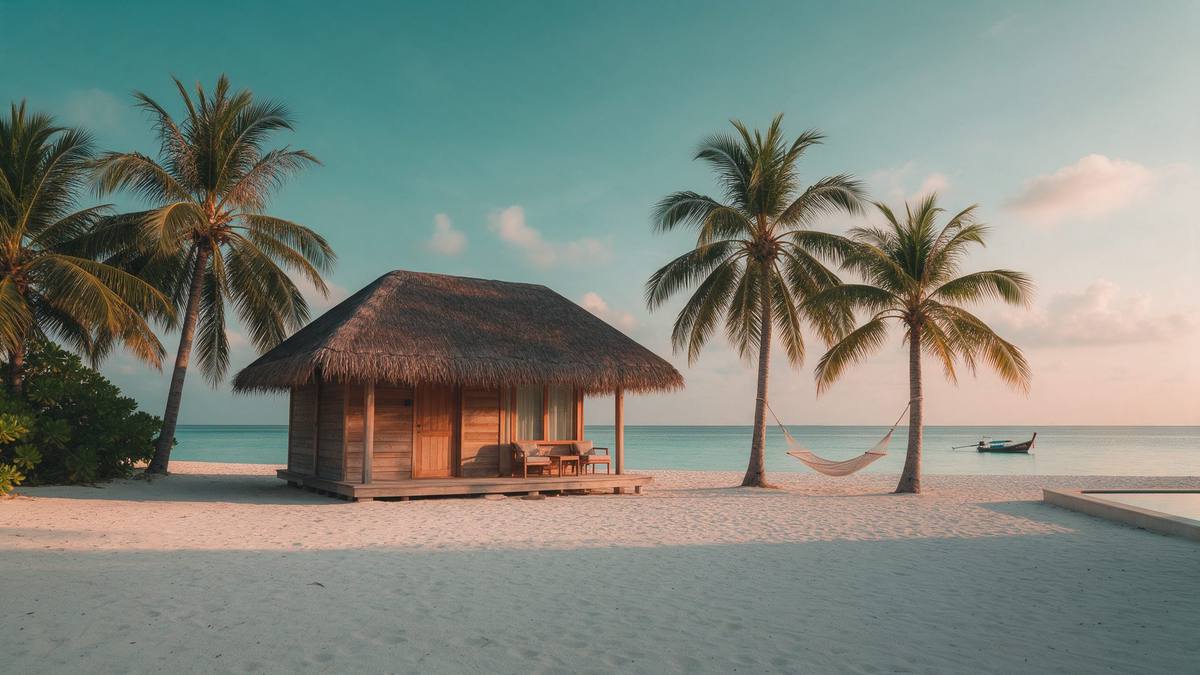
Bungalow: a free-standing hut, common on the islands. The simple ones are made of wood or bamboo, larger ones of stone with air conditioning.
Apartment and condo: a flat with a kitchen, mostly for longer stays. Good for a week or more, or if you want to cook for yourself.
Airbnb and holiday rental: private accommodation via a platform; the legal situation is covered further down.
What a night costs
There is no official price list. The figures below are advertised prices (“from”) for a room for one or two people for the night from Saturday, 31 October, to Sunday, 1 November 2026, retrieved on 25 October 2026. The dormitory is priced per bed. This is the start of the high season, and prices are higher in the Christmas weeks (more on that in the next section). These are example ranges taken from the listings, not averages.
| Type, euros per night | Bangkok | Chiang Mai | Phuket | Koh Phangan | Koh Lipe |
|---|---|---|---|---|---|
| Hostel dormitory | 6 to 13 | 3 to 15 | 5 to 20 | ||
| Basic room or bungalow | from 7 | 12 to 17 | 16 to 26 | from 11 | 20 to 24 |
| Mid-range with pool | 30 to 44 | 36 to 62 | 32 to 62 | 24 to 36 | 29 to 62 |
| Upscale, resort | 75 to 120 | 90 to 240 | 100 to 320 | 94 to 245 | 87 to 594 |
The Bangkok figures come from the cost guide, which also lists their sources. For Koh Lipe, the upper figure is a pool villa. I have not put other islands such as Koh Samui, Koh Lanta or Koh Tao in the table, because I have not read comparable figures for them.
High season, low season and the surcharges
On the Andaman Sea and in the Gulf, high season runs roughly from November to March, peaking between 20 December and 10 January. Chinese New Year in January or February also pushes prices up. In Chiang Mai, Loi Krathong and Yi Peng add to this in November. In the peak weeks the “from” prices rise noticeably, and some places demand minimum stays. In the south, prices from December to March are roughly 30 to 80% above low season. This is a rule of thumb from industry sources, not an official figure. For upscale hotels in Phuket, low-season discounts are around 40%. In the shoulder weeks, such as early November or the second half of February, they are more like 15 to 20%.
For Bangkok the swing is smaller. June is the cheapest month there and December the most expensive; details are in the cost guide.
The weather page shows when each place suits you weather-wise. The guide Best time to visit Thailand explains the background. Note that the coasts do not follow the same pattern: on Koh Samui, the heaviest rain falls from October to December.
If you are firmly planning for December and January, book accommodation and ferries early. My advice: two to four months ahead, with free cancellation, and check again if prices drop.
Where to stay
Bangkok: the train matters more than the stars
The Skytrain and the metro bypass the traffic jams, so it is best to stay within walking distance of a station. In Siam you can get anywhere, and Silom and Sathorn are quieter in the evening. The old town near the big temples is quiet at night, while Khao San Road is cheap, crowded and loud until late. You will sleep more quietly a few lanes away on Phra Athit Road. Sukhumvit Road has many faces. Around Nana there are red-light areas, while Phrom Phong is quieter and popular with families. Riverside hotels are usually the most expensive, but you can get around by boat.
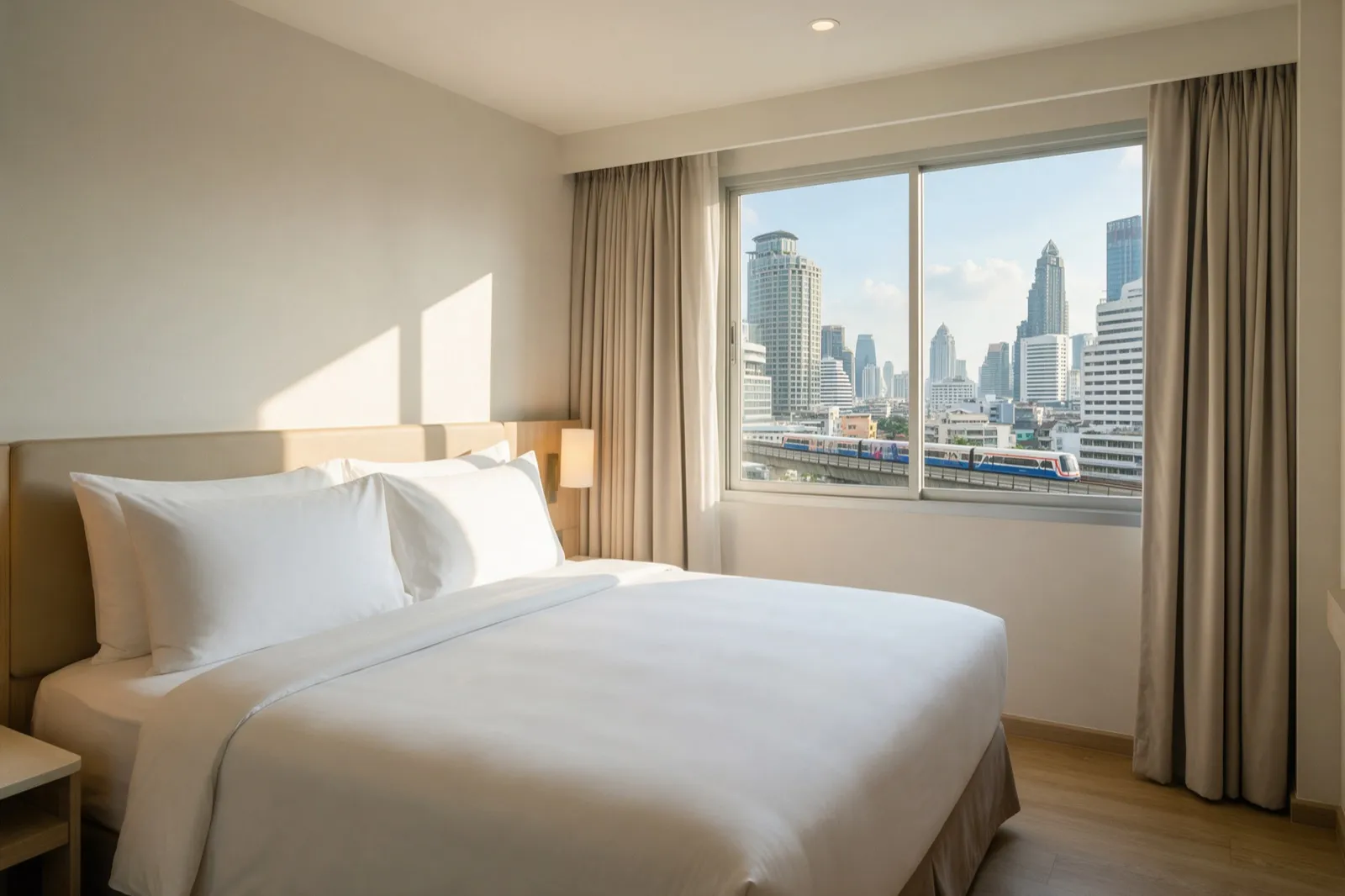
Riverside hotels are usually the most expensive, but you can get around by boat, around Siam and Silom you are close to the Skytrain and metro, and Khao San Road is cheap and loud. You can compare Hotels in Bangkok in advance by location and price.
Phuket: choose the beach first
On Phuket the beach decides, and without a car, scooter or taxi the distances are long. Patong is the party strip and is rarely quiet. Kata and Kamala are a good middle ground: quiet, but with restaurants. Mai Khao, Nai Yang and Nai Harn are very quiet, and almost nothing stays open there in the evening. If you want old town, cafés and markets, stay in Phuket Town and travel out for swimming.
Chiang Mai: old town, Nimman or the river
In Chiang Mai, the old town is the most convenient base for temples, and you can walk to almost everything. Nimman in the west is modern, with cafés, bars and shopping centres, but more densely built and crowded in the evening. It is quieter and more refined by the river around Wat Ket. There is always something going on at the Night Bazaar in the evening. If you need peace at night, ask when booking for a room facing the garden rather than the street.
On the islands: pier, noise and the last boat back
On the islands, location and getting there shape the night. On Koh Lipe, Pattaya Beach is at the pier, handy for a night or two, but liveliest in the evening. If you stay on Walking Street, you pay less and hear more at night. More on the page Koh Lipe. On Koh Samui, Chaweng is loud, Bophut is cosy, Maenam is quiet and Choeng Mon is good for families. On Koh Phangan, Thong Sala is handy for short trips to the harbour and the market, while Haad Rin is only worth it by day, unless you are there for the party. On Koh Lanta, you stay at Long Beach or in Klong Dao with restaurants around the corner.
The ferry often determines the first and last night. To Koh Tao, the last boats leave Thong Sala in the afternoon, and nothing goes in the evening. If you arrive late, spend the night on the previous island and plan the crossing for the next morning. The routes and times are summarised in the guide Getting around Thailand and on the page Island hopping.
Booking without nasty surprises
Compare the same room on two or three platforms and on the property’s own site. What counts is the final price with all taxes and fees, not the big price at the top of the list. For luxury hotels, “++” is often shown next to the price. Then 10% service charge and 7% tax are added. So 20,000 baht becomes about 23,540 baht.
Filter for free cancellation and read the deadline carefully, including the time. In low season, prices sometimes drop shortly before arrival. If you booked flexibly, you can then rebook. In high season it is usually the other way round.
Pay only through the platform where you booked. If the accommodation supposedly writes to you afterwards and wants your card details on another site, that is a known scam. The scammers know genuine booking details. If in doubt, call the property.
In many places check-in starts in the early afternoon, and check-out is around noon. If you land early, ask beforehand about luggage storage. Keep the address of your first accommodation ready, because the digital arrival card (TDAC) asks for it. How entry works is explained in the guide Entering Thailand.
TM30, passport copy and deposit
Hotels and guesthouses, and private landlords too, must report foreign guests to the immigration office within 24 hours. The form is called TM30, and the obligation lies with the host, not with you. For this they need your passport details, as a rule a copy of the photo page, the visa page and the entry stamp. Hotels do this at check-in. Anyone who fails to report risks a fine: up to 2,000 baht for ordinary landlords, 2,000 to 10,000 baht for hotel managers.
For you this usually matters only if you later apply for something at immigration, such as an extension. Then the TM30 receipt is required. For longer stays in private accommodation, you should therefore ask whether the landlord files the report.
Foreigners must carry their ID at all times; a copy is enough if the page with the visa or entry stamp is copied too. ID checks are frequent, especially in the entertainment districts of Bangkok and in Pattaya, Phuket and Chiang Mai. My tip: have the hotel copy or scan it, and take your passport back. Some small places keep the passport overnight for the report. That does happen, but you can ask for a copy.
A deposit is usual, especially from mid-range upwards. This is mostly an amount on the credit card that is blocked and released at check-out, or cash in a guesthouse for the key. The amount varies from a few hundred to a few thousand baht. Ask how it is returned, and get a receipt for the amount.
Traps and scams
Nice photos, different reality. Look at the most recent reviews with guest photos, not at the property’s own pictures. My rule of thumb: if there are almost no guest photos, stay sceptical.
Fees by message. If the accommodation asks after booking for a “processing fee”, a “card guarantee” or a link for verification, do not reply. This is the known scam from the section above.
Rental damage. In some tourist hotspots, gangs work together with corrupt police officers and accuse tourists of having damaged rented scooters or jet skis, in order to extort money. The police station at Patong Beach has been particularly conspicuous. Take photos of the condition before you ride. In case of extortion, contact the German embassy in Bangkok.
More on everyday fraud is in the guide Scams and safety in Thailand.
Airbnb and holiday rentals: the legal situation
Anyone who rents out a flat or house for under 30 days falls under the hotel rules of the 2004 Hotel Act and needs a licence. Accommodation that is let only monthly or longer is exempt. This is the well-known 30-day rule. For condominiums, the Condominium Act additionally prohibits commercial use, and many buildings cover short-term letting in their house rules. Since 2023, small properties with up to eight rooms and 30 guests can register with the responsible authority instead of obtaining the full licence; this suits a detached house better than a flat in a tower block.
Unlicensed hosts risk up to one year in prison and/or a fine of up to 20,000 baht, plus up to 10,000 baht for each day the violation continues. In 2025 the authorities prosecuted several illegal condominium hotels in Bangkok. On the booking page you cannot see whether a host is operating legally.
For you this means: the penalties mentioned are aimed at the hosts. But a cancellation shortly before arrival, a dispute with the building management or being refused entry are all possible (this is my assessment). For a flat in a tower block, ask the host beforehand whether guests are allowed. With a house, a villa or accommodation with a hotel licence, the risk is smaller. And from 30 nights, a monthly rental contract is the clean way. Since 15 September 2026, immigration has granted a maximum of 30 days on visa-free entry. The connection is explained in the guide Wintering in Thailand from 50.
Frequently asked questions
How much does accommodation in Thailand cost per night?
A dormitory bed in Bangkok, Chiang Mai and Phuket costs about €5 to €20. A basic room is about €7 to €26 depending on the place, mid-range with a pool about €24 to €62. Beach hotels and resorts start at around €90. These are example prices for one night at the end of October 2026; in high season they are higher.
Do I have to hand over my passport at the hotel?
You have to show it, because the hotel needs your passport details for the TM30 report. A copy or scan is usually enough. Some small places keep the passport overnight, but you can ask for a copy. You should never give it as a deposit for a scooter or jet ski.
What is the TM30 and do I have to do anything?
The TM30 is the accommodation’s report to the immigration office. It must be made within 24 hours of your arrival, and the obligation lies with the host. Hotels do this at check-in. It only becomes important for you if you later apply for something at immigration, for example an extension.
Is Airbnb legal in Thailand?
Short-term letting for under 30 days falls under the Hotel Act and needs a licence or, for very small properties, a registration. In condominiums it is usually also problematic under the Condominium Act and the house rules. The penalties hit the hosts, but you still face a risk of cancellations and trouble with the building management.
What does “++” mean in a hotel price?
On top of the stated price come 10% service charge and 7% tax, together about 17.7%. So 20,000 baht becomes around 23,540 baht. Pay attention to the final price when booking.